
Carpal Tunnel From Typing: Causes & Recovery | BossAI
Carpal Tunnel From Typing: Causes, Data, and Recovery That Works
Typing less than 20 hours per week probably didn't cause your carpal tunnel. Research consistently shows wrist angle during typing matters more than raw keyboard volume — and that distinction is useful, because angle is fixable. Carpal tunnel syndrome affects 3–6% of adults, with desk workers typing 20+ hours weekly in poor posture showing two to three times the baseline incidence rate.
Key Takeaways
- Carpal tunnel from typing is driven primarily by wrist angle during typing, not total hours — fixing posture is the highest-leverage early intervention.
- Prevention requires four simultaneous changes: neutral wrist position, elbow at 90°, 60-second micro-breaks every 30 minutes, and reducing total typing volume.
- Mild carpal tunnel recovers in 3–6 weeks with rest and ergonomic correction; moderate cases take 3–6 months with splinting or physical therapy.
- Hands-free voice dictation eliminates typing entirely — maintaining full productivity during recovery without aggravating the injury.
- Symptoms persisting beyond 4 weeks despite conservative care warrant specialist evaluation; 10% of untreated cases eventually require surgery.
Contents
- What Is Carpal Tunnel From Typing?
- How Common Is Carpal Tunnel From Typing?
- What Are the Best Prevention Strategies for Carpal Tunnel?
- Can You Reverse Carpal Tunnel Damage From Typing?
- How Long Does Carpal Tunnel Recovery Take?
- Hands-Free Dictation: The Most Effective Carpal Tunnel Solution
- When Should You See a Doctor for Carpal Tunnel Syndrome?
What Is Carpal Tunnel From Typing?
Carpal tunnel syndrome occurs when the median nerve — passing through a narrow bony channel at the wrist — becomes compressed. During typing, wrist flexion raises pressure inside the carpal tunnel by 20–30 mmHg above neutral, reducing blood flow to the nerve. That pressure is the mechanism behind the numbness, tingling, and progressive weakness that define carpal tunnel from typing.
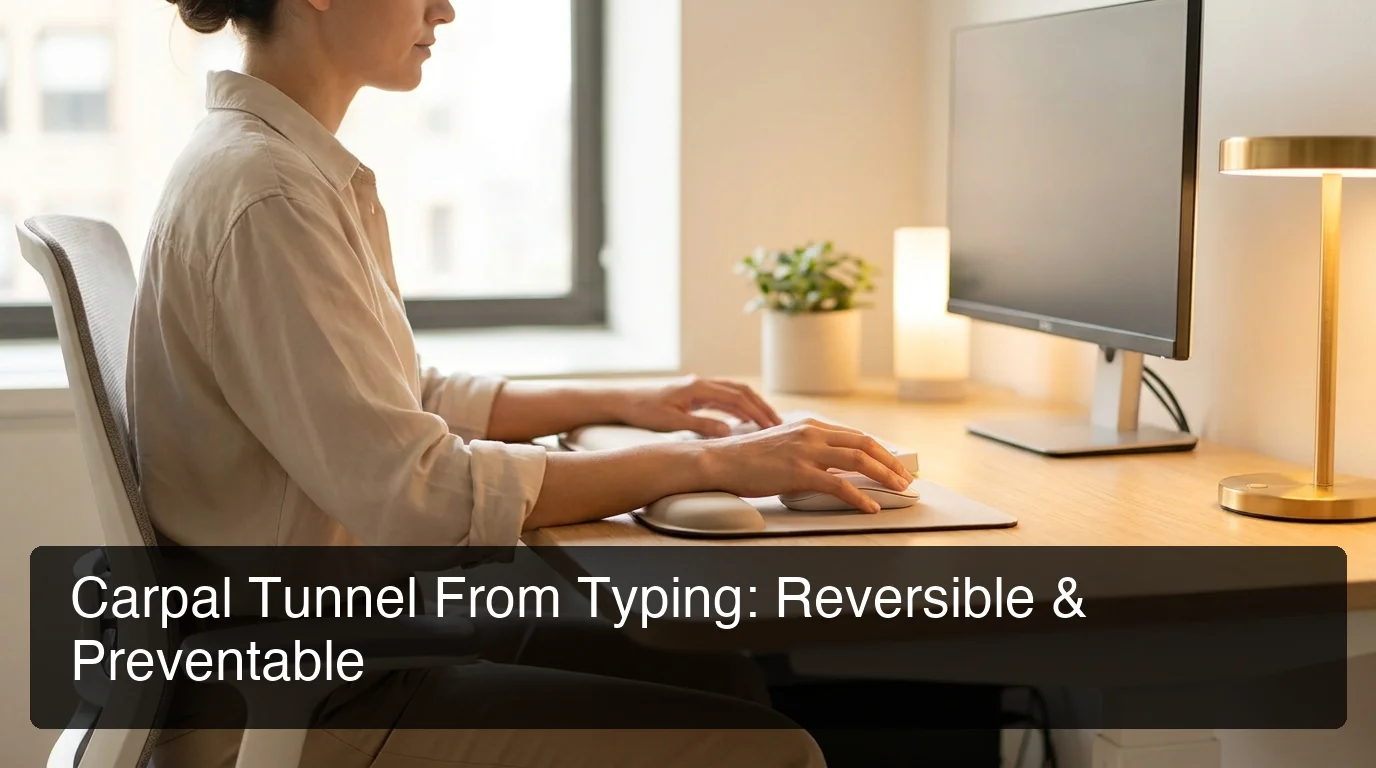 Ergonomic desk setup with wrist supports — neutral wrist angle reduces carpal tunnel pressure significantly.
The carpal tunnel is a rigid structure, shared by nine flexor tendons and the median nerve. Inflammation in those tendons — from repetitive motion — squeezes the nerve without any structural wrist damage. Early compression is fully reversible; sustained compression is not.
Vibrating tools, pregnancy, obesity, and thyroid conditions independently raise CTS risk. Some typists are managing a baseline condition that keyboard use pushes past the threshold — which is why ergonomic corrections matter even for moderate typing schedules.
Worth knowing: Night-only symptoms (tingling that wakes you up) is Stage 1. Daytime numbness that interrupts work is Stage 2. Grip weakness or thumb pinch failure is Stage 3 — that requires urgent evaluation, not watchful waiting.
How Common Is Carpal Tunnel From Typing?
Carpal tunnel syndrome affects roughly 3–6% of the adult population. Among desk workers regularly typing 20+ hours per week with poor wrist posture, occupational health data shows incidence running 4–8% — two to three times baseline rates. Women are diagnosed roughly three times more often than men, partly due to anatomical differences in tunnel size.
| Risk Factor | Impact Level |
|---|---|
| Typing >20 hrs/week with wrist flexion | High |
| Wrist bent >20° up or down during typing | High |
| Mechanical keyboard with heavy actuation force | Moderate |
| BMI >30 | Moderate |
| Female sex (smaller tunnel anatomy) | Moderate |
| Age >50 | Moderate |
| Diabetes or thyroid conditions | Moderate |
| Typing <20 hrs/week with neutral wrists | Low |
Software developers, data entry operators, and administrative workers represent the highest-prevalence professional groups. Journalists and transcriptionists follow closely. The common thread isn't typing speed or daily word count — it's sustained wrist position maintained for hours without decompression breaks.
What Are the Best Prevention Strategies for Carpal Tunnel?
Effective prevention bundles four interventions: neutral wrist position during typing (wrist flat, not angled up toward the screen), elbows at 90° with forearms parallel to the desk, mandatory 60-second micro-breaks every 30 minutes, and deliberate reduction of total typing volume. No single change is sufficient — clinical research supports bundled ergonomic interventions over any individual fix.
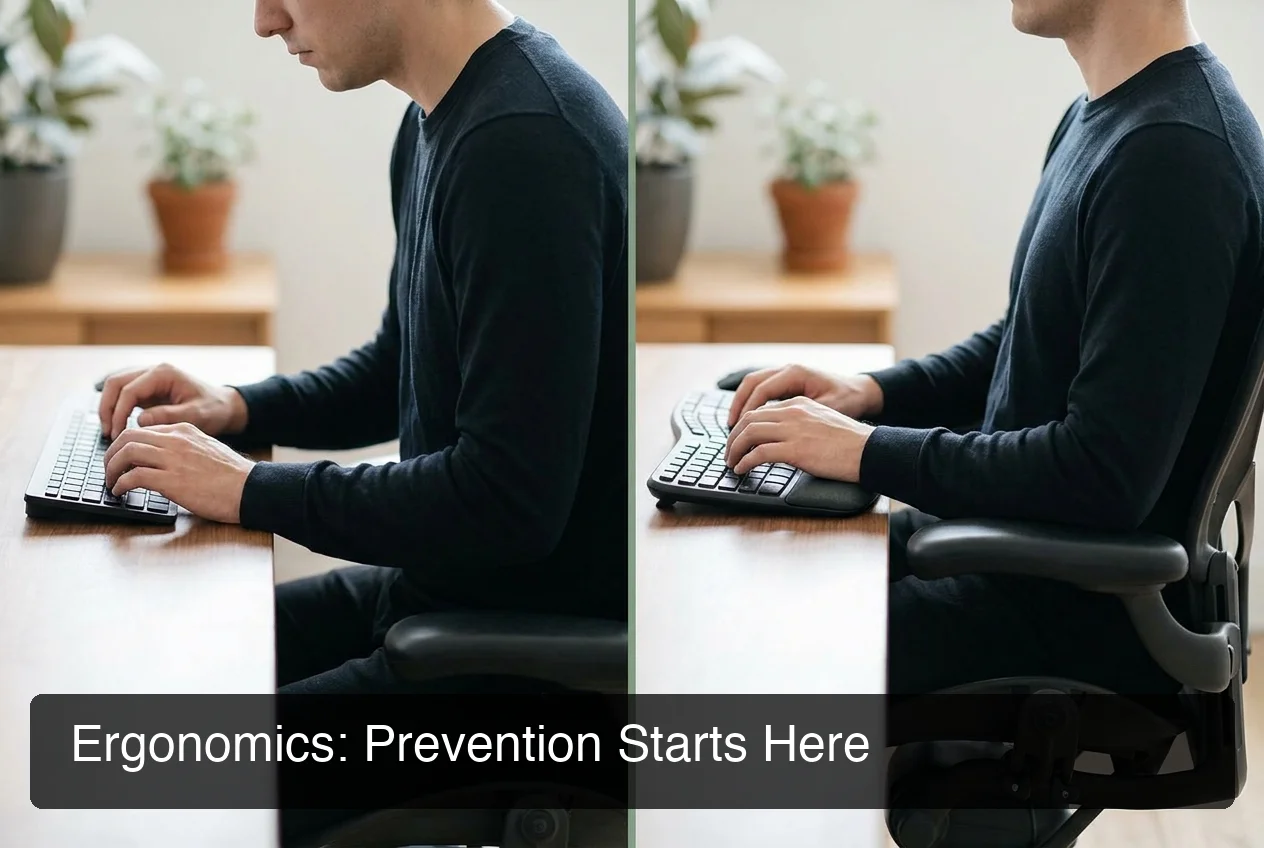 Left: wrist bent upward during typing — the primary driver of carpal tunnel pressure. Right: neutral wrist position with forearm parallel to desk.
A wrist rest belongs under your wrist during pauses — not while actively typing. Using one during keystrokes forces sustained extension against a fixed surface, which increases carpal tunnel pressure rather than reducing it.
Micro-breaks matter more than most people account for. Research on sustained typing sessions shows carpal tunnel pressure stays elevated for up to 10 minutes after stopping. Sixty-second breaks every 30 minutes allow tissue decompression before the next session starts.
Nerve gliding and wrist stretching exercises — gently extending fingers, rotating wrists through full range of motion — reduce tendon inflammation and maintain joint mobility. Most effective when done preventively, before pain develops.
Gear helps at the margin. Carpal tunnel gloves for typing redistribute palm pressure; split keyboards keep hands at a more natural shoulder-width angle; vertical mice eliminate forearm rotation load. These reduce cumulative strain without removing keyboard use entirely.
Quick win: Raise your keyboard so your wrists stay level with your forearms. Most standard desk setups position keyboards too low, forcing sustained wrist extension — a posture users maintain for hours without noticing it.
Can You Reverse Carpal Tunnel Damage From Typing?
Yes, with early intervention. Mild-to-moderate carpal tunnel syndrome — where compression is present but permanent nerve damage hasn't yet occurred — is fully reversible. The median nerve has significant healing capacity once sustained compression is removed. The critical variable is how long compression has continued before treatment begins.
Early-stage CTS (night symptoms, occasional daytime tingling) responds well to conservative management: ergonomic corrections, neutral-position night splinting, reduced typing load, and anti-inflammatory measures. Clinical data shows 60–70% of mild cases resolve completely with 6–8 weeks of consistent conservative care.
For wrist pain from typing you're already experiencing, start ergonomic changes immediately — don't wait for a specialist appointment. That head start compresses recovery time substantially.
Moderate cases — persistent daytime numbness that interferes with work — require structured intervention: physical or occupational therapy, corticosteroid injections for acute inflammation, and longer typing restrictions. This is where timelines stretch from weeks into months.
How Long Does Carpal Tunnel Recovery Take?
Recovery time maps directly to severity at the start of treatment. Mild carpal tunnel: 3–6 weeks with ergonomic changes and rest. Moderate cases with physical therapy and splinting: 3–6 months. Post-surgical recovery: 4–12 weeks for light activity, up to 6 months for full grip strength return.
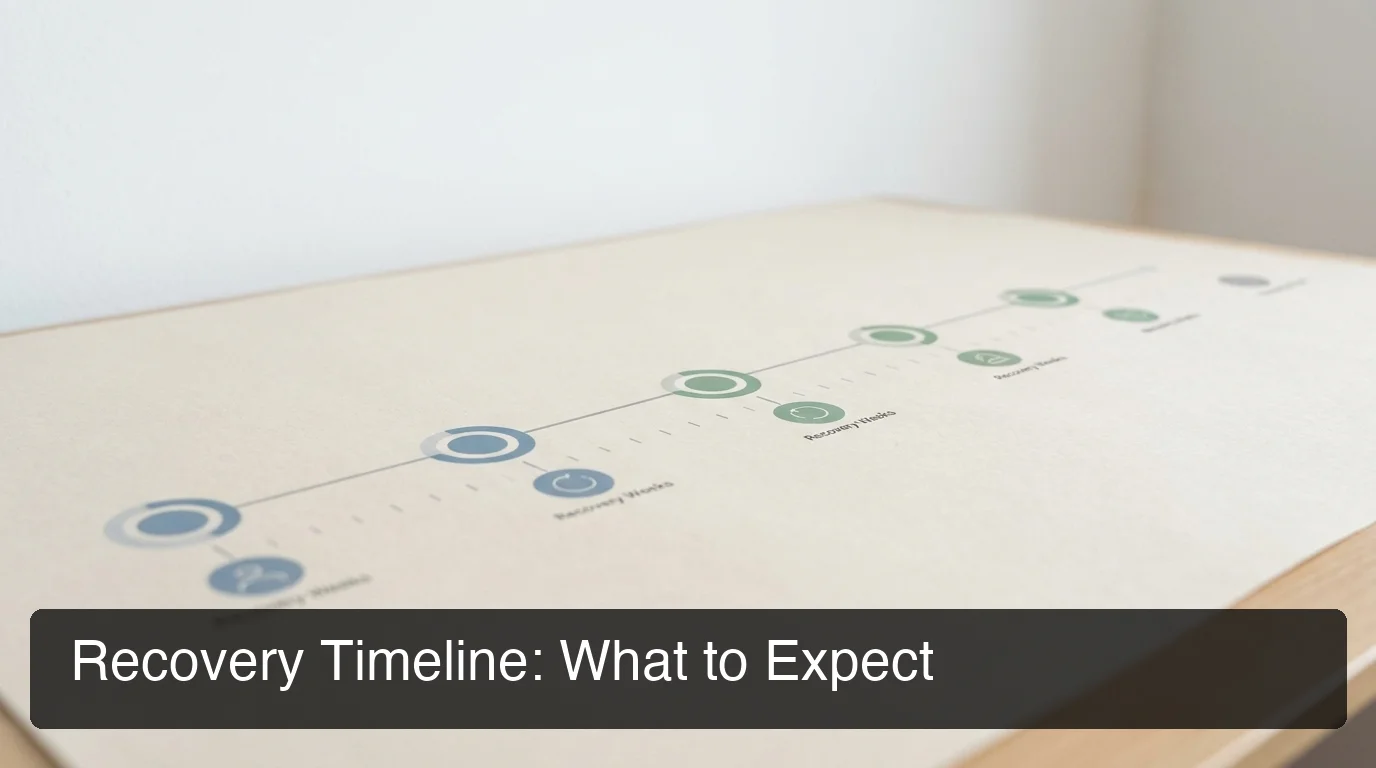 Most mild cases see significant improvement within 6 weeks of consistent ergonomic correction and night splinting.
| Severity | Primary Treatment | Recovery Window |
|---|---|---|
| Mild (night symptoms only) | Ergonomics + rest | 3–6 weeks |
| Mild–Moderate (daytime tingling) | Night splinting + ergonomics | 6–12 weeks |
| Moderate (interferes with work) | PT + corticosteroid injection | 3–6 months |
| Severe (weakness/atrophy) | Surgical release | 4–12 weeks post-op, 3–6 mo full |
Night splinting keeps the wrist in neutral position during sleep — when most people unconsciously flex their hands against pillows or their chest. Clinical studies show meaningful symptom improvement in 4–6 weeks for mild cases from night splinting alone. It's Stage 1–2's most effective conservative intervention with zero daytime disruption.
The window for conservative recovery narrows with time. Prolonged compression transitions from reversible conduction slowing to structural nerve damage. Start treatment before that shift happens.
Hands-Free Dictation: The Most Effective Carpal Tunnel Solution
The medical recommendation for carpal tunnel recovery is reduced typing. For professionals managing email, documents, and ongoing communications, "type less" isn't actionable without a replacement strategy. Voice dictation provides one: eliminate keyboard use without cutting output.
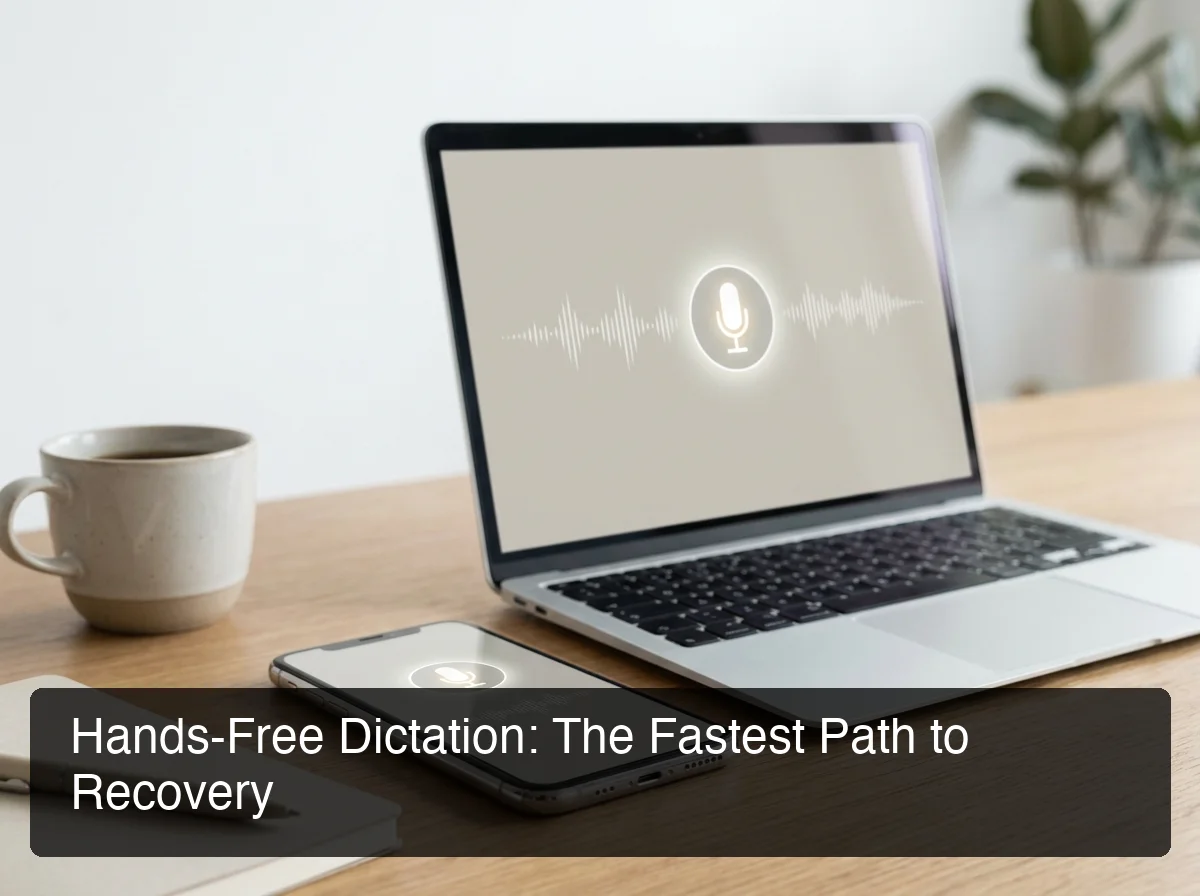 BossAI turns speech into polished, formatted text across every app — zero wrist involvement, full productivity during recovery.
BossAI's free tier provides 500 words/day of AI-enhanced dictation across iOS, Android, macOS, and Windows — no typing required at any step. It removes filler words automatically, corrects grammar, adds punctuation, and formats text for the app you're in. On mobile it replaces your keyboard entirely; on desktop a single hotkey activates dictation wherever the cursor sits.
For carpal tunnel recovery, BossAI eliminates the core mechanical driver — sustained wrist flexion — while maintaining full communication output. Voice dictation runs at 130–150 words per minute at natural speaking pace, compared to 40–55 for average typing. Switching during recovery isn't just protecting your wrist — it's faster.
For broader hands-free options during injury recovery, typing alternatives for disability covers the full toolkit of accessible productivity tools. And if you prefer capturing ideas on the go, a voice note recorder works as a lightweight complement to dictation during the recovery period.
When Should You See a Doctor for Carpal Tunnel Syndrome?
See a hand specialist if symptoms persist beyond 4 weeks of consistent conservative management, if you develop grip weakness or difficulty pinching with thumb and forefinger, if night symptoms wake you more than twice weekly, or if numbness has shifted from intermittent to constant. These are signals compression has advanced beyond what self-care addresses.
Carpal tunnel and rheumatoid arthritis present similarly — RA independently inflames tendon sheaths and can mimic nerve compression symptoms. Nerve conduction studies (NCS) and electromyography (EMG) distinguish between the two and prevent misdiagnosis. Treating the wrong condition adds months to recovery.
Roughly 10% of untreated or undertreated CTS cases eventually require surgical decompression — carpal tunnel release surgery cuts the transverse carpal ligament to free the nerve, with an 85–90% success rate. The earlier conservative treatment starts, the smaller that percentage becomes.
Get Started with BossAI
Reducing typing load is the most direct intervention for carpal tunnel recovery. BossAI makes it possible without sacrificing productivity — dictate everything, let your wrists recover on their own timeline.
Not ready to download? Get Our AI Productivity Guide — free tips on building a voice-first workflow that works for you.
Frequently Asked Questions
How do you fix carpal tunnel from typing?
Start with ergonomic corrections — neutral wrist, elbow at 90°, micro-breaks every 30 minutes — and add neutral-position night splinting to eliminate wrist flexion during sleep. Mild cases typically resolve within 3–6 weeks of consistent conservative management. Symptoms persisting beyond 4 weeks or involving grip weakness warrant a hand specialist and nerve conduction testing.
Can typing too much actually cause carpal tunnel?
Research shows typing under 20 hours weekly is unlikely to cause carpal tunnel independently. Wrist angle during typing is a stronger risk factor than raw volume — workers with sustained wrist flexion or extension develop CTS at two to three times the rate of those typing in neutral positions, even at the same hourly load. Posture is the primary variable to control.
What are the early symptoms of carpal tunnel syndrome?
The five primary early signals: numbness or tingling in the thumb, index, and middle fingers; wrist pain that worsens at night; sensation of swollen fingers with no visible swelling; weakened grip when pinching; and temporary relief from shaking the hand. Night-only symptoms appearing before daytime symptoms is the classic early-stage presentation — treat it then, not when symptoms become constant.
Is carpal tunnel from typing permanent?
Mild-to-moderate carpal tunnel caught early is fully reversible — the median nerve heals once sustained compression is removed. Only severe, long-neglected cases with structural nerve damage may result in permanent reduced sensation or grip weakness. Surgical release achieves full or near-full recovery in 85–90% of severe cases.
Can BossAI help with carpal tunnel recovery?
BossAI replaces keyboard use with voice dictation that works across every app on iOS, Android, macOS, and Windows — removing the mechanical cause of carpal tunnel aggravation without interrupting work. The free tier provides 500 words per day with a daily reset, stripping filler words and correcting grammar automatically. No typing required at any point in the workflow.