
Carpal Tunnel Gloves for Typing: Types, Cost & Alternatives
Carpal tunnel pain during typing doesn't arrive all at once. It starts as occasional wrist ache, sharpens into nighttime numbness, and eventually turns routine tasks — email, messages, documents — into something deliberate.
Compression gloves are usually the first thing people reach for. They're affordable, available without a prescription, and offer some immediate relief. Whether they actually solve the right problem is a question product listings won't answer.
 Carpal tunnel gloves reduce inflammation during typing sessions — but the right strategy goes beyond reactive support.
Key Takeaways
- Carpal tunnel gloves provide compression to reduce nerve inflammation but don't stop the root cause of repetitive strain — they're reactive, not preventative.
- The most effective gloves have graduated compression and wrist stabilization; they're worn during high-risk activities and removed during breaks to avoid dependency.
- Voice dictation like BossAI eliminates the need for typing gloves entirely by removing the keyboard contact that drives strain in the first place.
- Glove quality matters — premium brands like Mueller and Futuro significantly outperform generic options; proper fit is critical for both comfort and support.
- The most effective injury prevention path combines compression gloves for acute symptom management with voice typing as a long-term lifestyle shift.
Contents
- What Are Carpal Tunnel Gloves and How Do They Work?
- Do Carpal Tunnel Gloves for Typing Actually Help with Pain?
- Which Carpal Tunnel Gloves for Typing Work Best?
- How Much Do Compression Gloves for Carpal Tunnel Cost?
- Should You Wear a Carpal Tunnel Glove While Typing?
- What's the Best Time to Wear Carpal Tunnel Gloves?
- When Gloves Aren't Enough: Voice Typing as Prevention
- Can Voice Typing Replace Carpal Tunnel Gloves?
- Try BossAI Free
- Frequently Asked Questions
What Are Carpal Tunnel Gloves and How Do They Work?
Carpal tunnel gloves are compression-based hand supports that reduce swelling, improve local circulation, and stabilize the wrist during activities that stress the median nerve. They apply graduated pressure around the palm and wrist to limit fluid buildup inside the carpal tunnel — the narrow bony channel through which the median nerve passes into the hand.
The carpal tunnel itself is formed by wrist bones and a band of connective tissue called the transverse carpal ligament. When swelling from repetitive motion — like sustained keyboard use — compresses the median nerve inside this channel, it produces the signature symptoms: tingling and numbness in the thumb, index, and middle fingers, plus a grip that weakens under load.
Compression gloves act on two mechanisms: graduated pressure reduces edema around the joint, and wrist stabilization limits the flexion and extension positions that amplify pressure on the nerve.
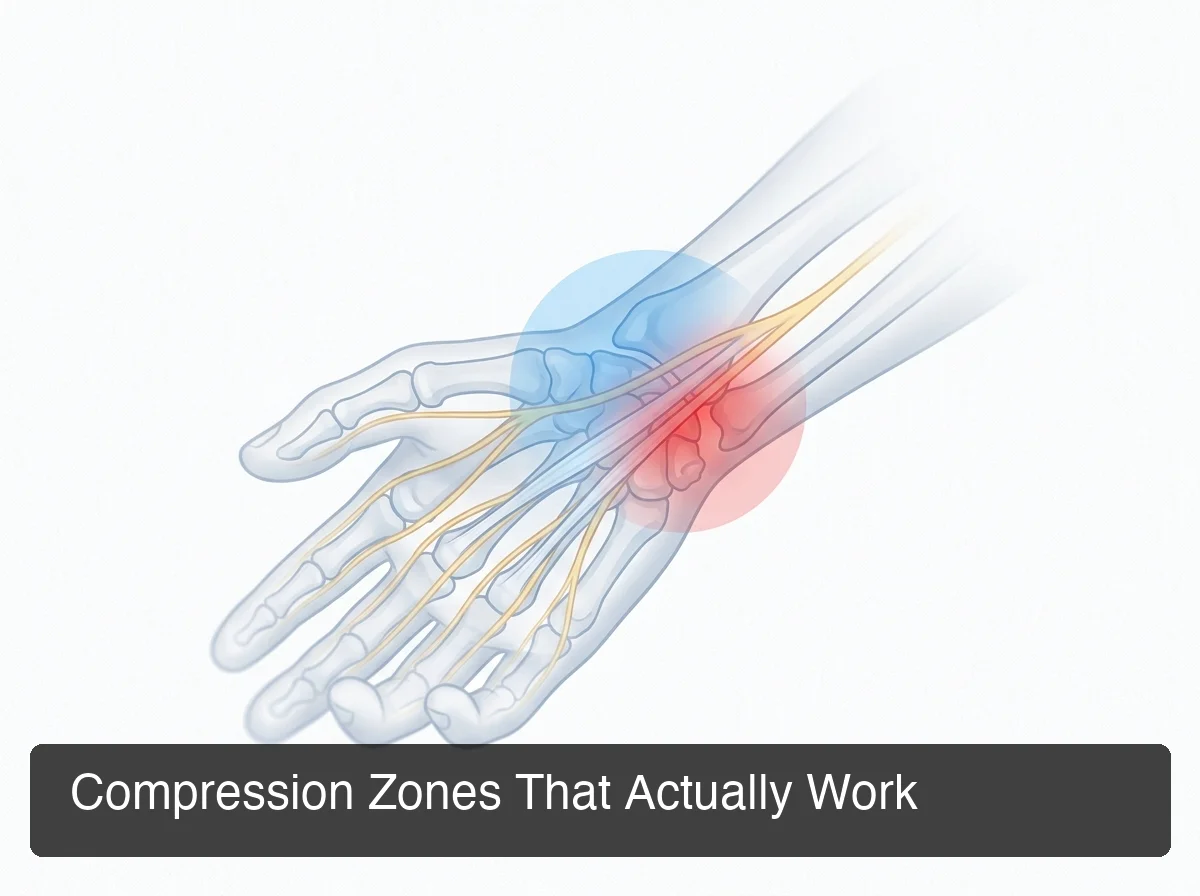 Graduated compression targets the wrist and palm specifically — the zones where nerve inflammation accumulates during repetitive keyboard use.
The Three Main Glove Types
Not all carpal tunnel gloves serve the same function. Three types show up across medical recommendations and consumer searches:
- Fingerless compression gloves — Cover the palm and wrist, leaving fingers fully free. The best format for active typing: full tactile access to keys, moderate support throughout a work session. Most widely recommended for computer use.
- Full wrist splints — Rigid or semi-rigid supports with a stabilizer bar that holds the wrist in neutral. Far more effective for severe symptoms and nighttime use; too restrictive for extended keyboard work.
- Copper-infused compression gloves — Fingerless design with copper-fiber fabric. Some manufacturers claim antimicrobial and anti-inflammatory benefits from the copper itself; clinical evidence for this is limited. The compression mechanism carries the therapeutic load.
Do Carpal Tunnel Gloves for Typing Actually Help with Pain?
Yes — carpal tunnel compression gloves provide meaningful symptom relief for most users with mild to moderate pain. Clinical studies on wrist orthoses show improvements in grip strength, pain intensity scores, and functional mobility. The important qualifier: gloves manage symptoms; they don't treat the underlying nerve compression or reverse existing median nerve damage.
The medical consensus is supportive, conditional on severity. Splinting — holding the wrist in neutral position — has consistent evidence for reducing carpal tunnel symptoms, particularly when worn at night to prevent unconscious wrist flexion. Daytime compression gloves have less formal clinical evidence but strong user-reported relief during repetitive-motion work.
Worth knowing: Gloves work best in the early and mid stages of carpal tunnel syndrome. Severe CTS — constant numbness, thenar muscle atrophy at the base of the thumb, or failed conservative treatment — typically requires surgical decompression. No glove changes that outcome.
The ceiling here matters. Gloves address the result of repetitive strain without changing the behavior producing it.
Every session back at the keyboard resets the inflammatory cycle. The compression reduces inflammation from the current session; the next session rebuilds it.
 Removing keyboard contact from the workflow removes the mechanical load on the carpal tunnel — the problem that gloves can only partially offset.
Which Carpal Tunnel Gloves for Typing Work Best?
For typing specifically, fingerless compression gloves with 15–20 mmHg graduated compression outperform rigid splints (too restrictive for keys) and basic elastic sleeves (insufficient support). Mueller, Futuro, and Copper Compression are the most consistently recommended brands across occupational therapy guidance and consumer reviews.
Here's how the main options compare for keyboard-heavy work:
| Glove Type | Typing Usability | Pain Relief | Price Range | Best For |
|---|---|---|---|---|
| Fingerless compression | Excellent | Moderate | $15–$35 | Active typing sessions |
| Wrist stabilizer splint | Poor | High | $20–$45 | Night use, severe pain |
| Copper-infused fingerless | Excellent | Moderate | $20–$40 | Comfort-focused daily use |
| Gel-pad computer gloves | Good | Low–Moderate | $15–$25 | Light desk and mouse use |
| Full-hand compression | Poor | Moderate | $20–$35 | Non-typing hand tasks |
For sustained keyboard work, the choice quickly narrows to fingerless compression. You need full finger mobility and tactile feedback on keys; a rigid splint eliminates both. Among specific brands:
- Mueller Green Fitted Wrist Brace — Rigid stabilizer bar for neutral alignment, adjustable straps. Clinical-grade support for more acute symptoms.
- Futuro Comfort Wrist Support — Softer dual-strap design, washable, consistently well-reviewed for all-day wear.
- Copper Compression Arthritis Gloves — Popular for warmth and fit; compression is mild compared to medical braces, but comfort ratings are high.
Why Brand Quality Matters
Generic gloves under $8 use inconsistent compression grading and elastic that loses tension within weeks. Effective compression requires consistent pressure across a defined mmHg range — cheap elastic approximates this on day one and degrades fast. For active carpal tunnel management, $20–$40 is the functional floor.
How Much Do Compression Gloves for Carpal Tunnel Cost?
Carpal tunnel compression gloves range from $4 to $58. Effective, medically-appropriate options fall in the $20–$40 band. Budget options under $15 use lower-grade elastic that degrades quickly; premium options above $40 from medical supply brands offer more durable compression and better fit specifications.
Price tiers and what they get you:
- Under $10 — Generic sleeves, inconsistent compression, minimal wrist support. Light comfort only.
- $15–$30 — Consumer-grade fingerless gloves (Copper Compression, Mueller standard). Washable, reasonable for daily office use.
- $30–$45 — Medical-grade braces with adjustable stabilizers and durable graduated compression. The practical sweet spot for diagnosed carpal tunnel.
- $45–$60 — OT/physical therapy grade. Maximum compression, often used under clinical supervision.
The short version: Spend at least $20 on any glove you plan to wear during work hours. Sub-$10 options compress the elastic fibers after 2–3 weeks and provide false confidence — the wrist feels supported when it isn't.
Should You Wear a Carpal Tunnel Glove While Typing?
Fingerless compression gloves during active typing sessions: yes. Full rigid wrist splints: generally no. Rigid splints restrict the wrist mobility range needed for accurate typing and create compensatory strain in the fingers and forearms. The right format for keyboard work is a soft compression glove without a stabilizer bar.
Fit is the most common failure point. Too tight across the palm cuts circulation and worsens symptoms. The correct sensation: firm uniform pressure across the wrist and palm, no tingling in the fingertips while wearing.
Posture Still Matters
Compression gloves don't fix typing posture. The two main mechanical contributors: wrist extension (hands bent upward above forearms) and ulnar deviation (wrists angled outward, common on laptop keyboards). A compression glove supports the wrist within its natural range — it doesn't force neutral alignment. Poor posture means the strain continues even with a glove on.
Common mistake: Wearing gloves consistently throughout the workday without scheduled breaks. Even the best compression gloves don't substitute for the physiological recovery benefit of stopping repetitive motion entirely. Build in 10–15 minute break windows every hour; remove the gloves during breaks to let circulation recover.
What's the Best Time to Wear Carpal Tunnel Gloves?
Carpal tunnel gloves are most effective during high-risk activities (typing, writing, gripping) and during sleep — the two windows when nerve compression is highest. Most occupational therapists recommend fingerless compression gloves during work hours and a rigid nighttime splint during sleep, when unconscious wrist flexion narrows the carpal tunnel most aggressively.
The standard protocol:
- During work hours — Fingerless compression gloves during keyboard sessions. Remove during 15–30 minute breaks to restore circulation.
- At night — Rigid wrist splint, not a compression glove. The splint holds the wrist in neutral during sleep, preventing the flexion that causes morning numbness.
- Recovery periods — No glove. Tissue needs uncompressed recovery time; continuous wear weakens stabilizing muscles through disuse.
Avoid all-day continuous wear. Gloves are a targeted intervention, not a permanent fixture.
When the gloves come off and you return to eight-hour sessions, the inflammation cycle restarts. This is the ceiling of reactive support gear.
When Gloves Aren't Enough: Voice Typing as Prevention
 BossAI works across iOS, Android, macOS, and Windows — replacing keyboard sessions across your entire workflow, not just one device.
Compression gloves manage the consequences of a behavior you haven't changed. The behavior — sustained keyboard use — continues every session. This is why occupational therapists describe compression gloves as the first tool in a recovery plan, not the final one.
The root cause of typing-induced carpal tunnel is cumulative mechanical load on the median nerve. The only complete solution is reducing that load — spending less time on the keyboard, not only adding support gear while continuing at the same volume.
BossAI's voice dictation directly addresses this. Speaking naturally generates polished text across every app — email, Slack, documents, notes — with no keyboard contact. No wrist extension, no repetitive keystroke motion, no cumulative nerve compression.
BossAI runs as a native keyboard on iOS and Android and as a system app on macOS and Windows. You dictate in Gmail, Notion, or Slack exactly as you'd type — no copy-paste, no app switching. The AI removes filler words and corrects grammar in approximately 300 milliseconds.
Users managing carpal tunnel use it to make their workflow keyboard-optional — reducing daily keystroke volume to a threshold that compression gloves can handle, or eliminating the need for gloves entirely. See BossAI for RSI: Can Voice Typing Eliminate Hand Pain?
Can Voice Typing Replace Carpal Tunnel Gloves?
Voice dictation can replace carpal tunnel gloves for typing workflows by eliminating the behavior that drives the injury rather than managing its effects. Gloves remain useful for tasks that require hand use regardless — handwriting, physical work, gripping tools. But for keyboard-heavy digital work — email, messaging, documentation — voice typing removes the need for protective gear at the source.
Two strategies, one contrast:
- Carpal tunnel gloves — Reduce inflammation session by session. They help you type with less damage. They don't help you stop typing.
- Voice dictation — Removes the typing activity entirely. No repetitive keystroke motion means no accumulation of carpal tunnel strain from keyboard use.
For acute pain, a two-phase approach works: use compression gloves short-term to manage inflammation while still working, then shift progressively to voice-first workflows. The gloves handle the current pain; voice typing prevents the next episode.
For severe limitations — like typing with a broken wrist — voice dictation becomes the primary solution rather than a supplement. And for professionals whose workday requires sustained text output, hands-free typing resets the math entirely.
Try BossAI Free
If keyboard volume is driving your carpal tunnel symptoms, the most direct fix is reducing that volume — not managing it indefinitely with support gear. BossAI replaces typing sessions with voice dictation across every app on iOS, Android, Mac, and Windows. The free tier includes 500 words of dictation daily with no weekly cap or credit card required.
Not ready to switch workflows yet? Get Our AI Productivity Guide — practical strategies for reducing typing strain without changing your output.
Frequently Asked Questions
What helps carpal tunnel when typing?
Three interventions reduce carpal tunnel pain during typing: fingerless compression gloves to stabilize the wrist, ergonomic posture adjustments to maintain wrist neutrality, and reduced typing volume. Voice dictation is the most effective long-term intervention — it eliminates repetitive keystroke motion without reducing text output speed or volume.
Do carpal tunnel gloves work?
Yes, for mild to moderate symptoms — wrist splinting has consistent clinical evidence for nighttime relief and improved grip function. Gloves manage symptoms; they don't treat the underlying nerve compression or prevent recurrence if high-volume typing continues. Early-stage CTS responds best; severe cases typically require clinical treatment.
Do compression gloves help with typing pain?
Yes. Fingerless compression gloves worn during typing sessions reduce median nerve inflammation and limit wrist positions that worsen compression — most users report reduced tingling and better grip during work hours. Relief is most pronounced in early-stage carpal tunnel; results for long-standing or severe cases are more variable.
Should I wear a carpal tunnel brace while typing?
Fingerless compression gloves — yes. Rigid wrist splints — generally no; they restrict the wrist mobility needed for accurate typing and can shift strain into fingers and forearms. For keyboard work, choose a soft compression glove without a rigid bar and reserve rigid splints for sleep.
Is BossAI good for carpal tunnel?
BossAI is designed for zero-keyboard use. Users with carpal tunnel, RSI, and repetitive strain injuries dictate emails, messages, and documents entirely by voice — no typing at any stage. It works as a native keyboard on iOS and Android and a desktop app on macOS and Windows. The free tier includes 500 words per day, daily reset, no weekly cap.
What's the difference between carpal tunnel gloves and wrist splints?
Carpal tunnel gloves are soft compression garments providing moderate support while preserving full hand mobility — suited for active work and typing. Wrist splints include a rigid stabilizer bar that prevents flexion and extension more aggressively, making them better for severe symptoms and nighttime use where mobility isn't required. Most occupational therapists recommend gloves for daytime work and splints for sleep.
How long should you wear carpal tunnel gloves per day?
Most occupational therapists recommend up to 4–6 hours during high-strain activity, with 15–30 minute breaks to restore circulation. All-day wear weakens wrist stabilizer muscles through disuse. For sleep, switch to a rigid splint — it holds the wrist in the neutral position that prevents nighttime numbness, which compression gloves don't do.