
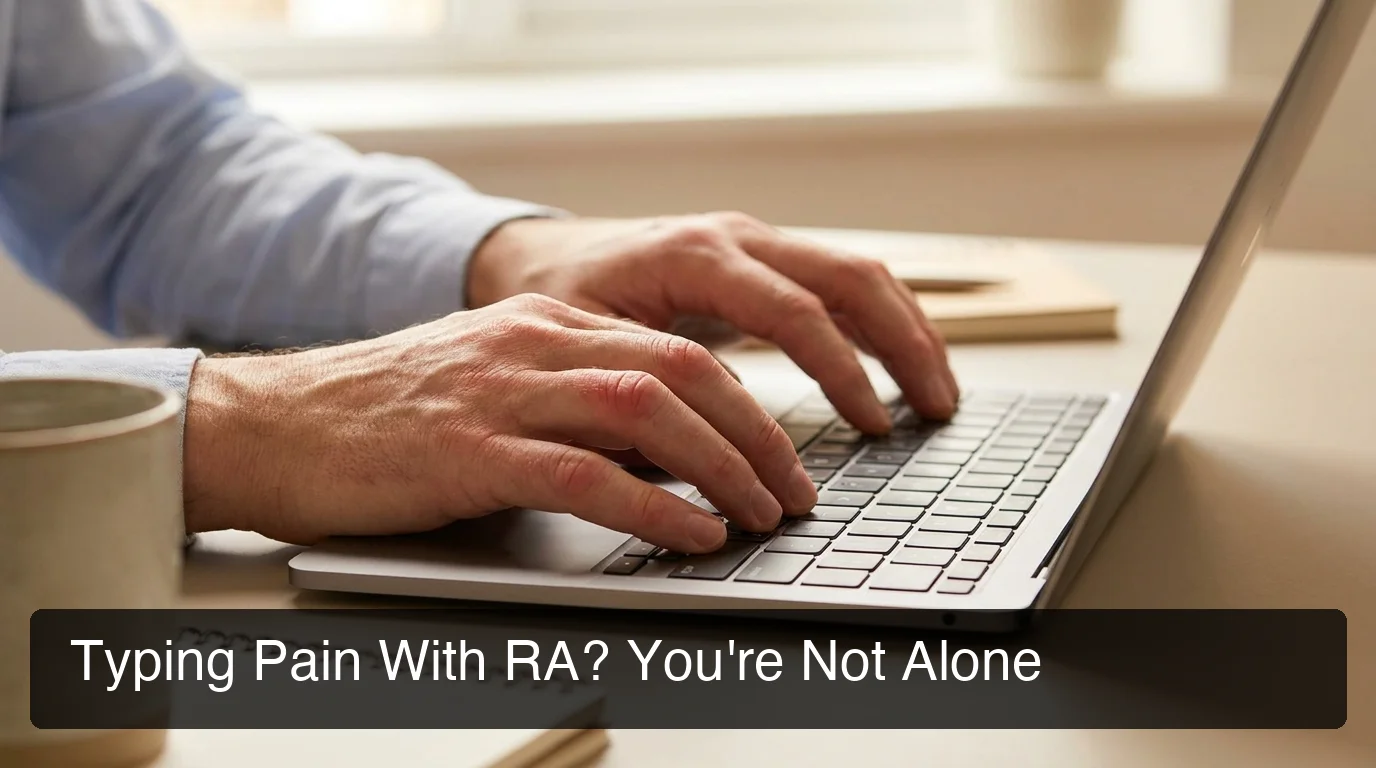
Rheumatoid Arthritis Typing: Pain, Data & What Works
Rheumatoid Arthritis Typing: Pain, Data & What Actually Works
Rheumatoid arthritis directly attacks the small joints that typing depends on. For the approximately 1.3 million Americans living with RA, every email, every Slack message, and every document carries a cost paid in joint inflammation and morning stiffness.
The question isn't whether RA affects typing — research is clear that it does. The question is what actually works.
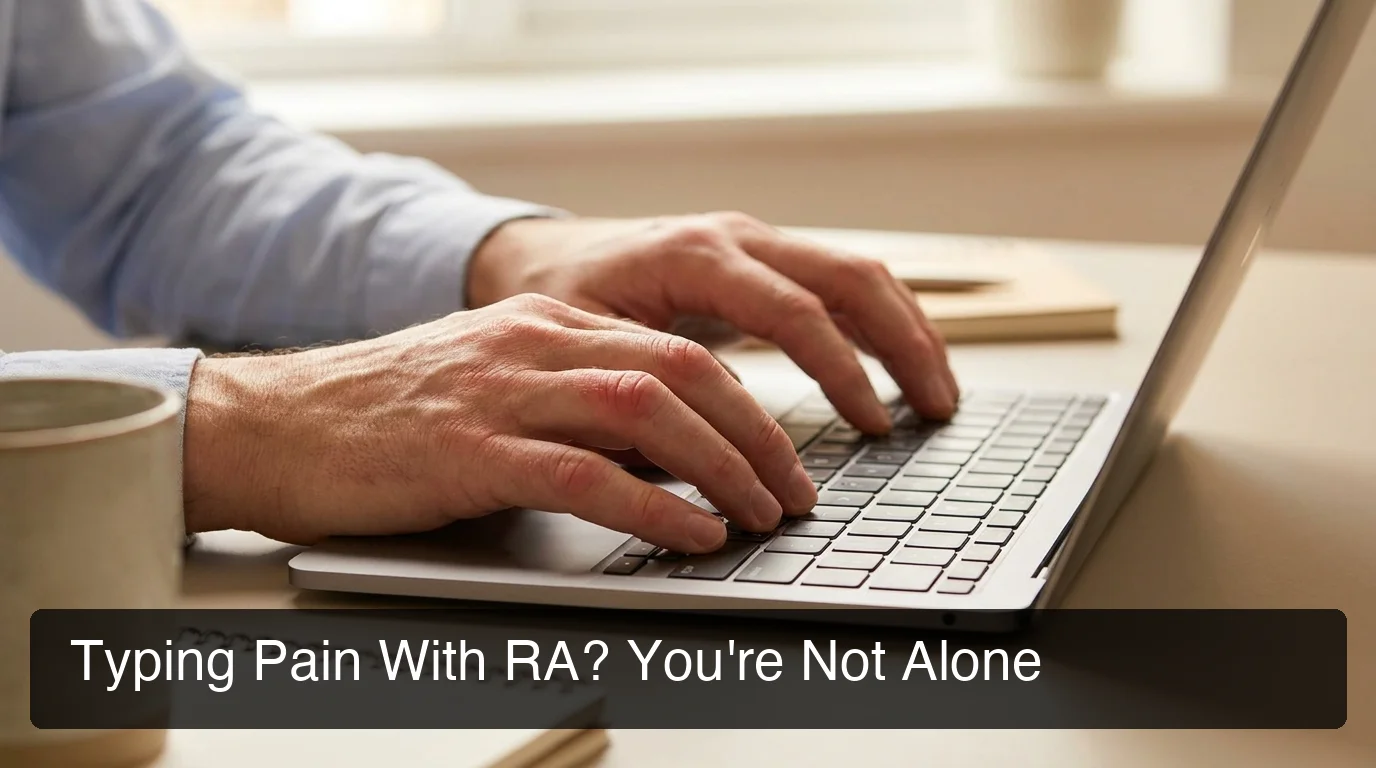 RA-related hand inflammation makes standard keyboard use painful — and over time, damaging to the joints typing loads most.
Key Takeaways
- Rheumatoid arthritis affects approximately 1.3% of the U.S. population and primarily targets the small joints of the hands — the same joints typing demands most.
- A peer-reviewed study found RA patients adopt compensatory keyboarding styles that reduce typing productivity and increase joint stress.
- Voice dictation eliminates the physical load of typing entirely and is recommended by occupational therapists for RA hand management.
- BossAI's hands-free dictation removes filler words, fixes grammar, and adds punctuation automatically — 500 words/day free with daily reset, no typing required.
- Combining voice dictation with ergonomic tools and occupational therapy exercises creates a sustainable long-term approach for people who need to write with RA.
Contents
- What Is Rheumatoid Arthritis and How Does It Affect Typing?
- Can You Still Type With Rheumatoid Arthritis?
- What Are the Best Rheumatoid Arthritis Typing Alternatives?
- How Can Hands-Free Dictation Help With Rheumatoid Arthritis?
- What Ergonomic Solutions Ease Rheumatoid Arthritis Typing Pain?
- Is Dictation Software Safe for People With RA?
- Frequently Asked Questions
What Is Rheumatoid Arthritis and How Does It Affect Typing?
Rheumatoid arthritis is an autoimmune disease where the immune system attacks the synovial lining of joints, causing chronic inflammation, pain, and progressive joint damage. Up to 90% of RA patients develop hand involvement — the metacarpophalangeal joints, proximal interphalangeal joints, and wrists — which are precisely the structures that keyboard use loads the most.
RA differs from osteoarthritis. It isn't wear-and-tear degradation; it's an immune attack that erodes cartilage and bone.
Flares intensify swelling and stiffness; remission periods offer partial relief. Neither state makes standard keyboard use comfortable.
Morning stiffness is a signature RA symptom. Patients often report stiffness lasting 30 minutes to several hours after waking — exactly when most people begin working. Typing through morning stiffness isn't just painful; it can worsen inflammation in already-stressed joints.
By the numbers: Roughly 1.3 million U.S. adults have RA. More than 70% have hands as the primary site of involvement, and approximately 60% report difficulty with fine motor tasks — including typing — within 10 years of diagnosis.
How RA Changes the Physics of Typing
Standard keyboarding loads the flexor tendons and finger joints repeatedly across a workday. For healthy hands, that's manageable. For RA hands, inflamed synovial tissue absorbs each keystroke differently — generating pain signals faster and recovering more slowly between inputs.
Research published in Arthritis Care & Research (indexed on PubMed) found that computer operators with RA adopted compensatory keyboarding styles — modified hand positions, reduced finger use — that reduced typing speed and increased joint stress relative to standard technique. The pattern is consistent: RA forces adaptation, and adaptation has a ceiling.
Can You Still Type With Rheumatoid Arthritis?
Yes — many people with RA continue typing. But "still able to type" and "typing without harm" are different questions. RA patients who type heavily often report worsening hand function over time, and some use increased typing discomfort as an early flare indicator.
Whether to continue depends on current joint status, flare frequency, and available alternatives.
The clinical picture is nuanced. Light, infrequent typing with ergonomic accommodations is generally tolerable.
Heavy keyboard use during flares is a recognized aggravating factor. Occupational therapists who work with RA patients consistently recommend reducing repetitive finger loading — and keyboard use is the highest-frequency repetitive hand task in most modern office jobs.
 The data on RA and typing impact is unambiguous — hand involvement is the norm, not the exception.
What Are the Best Rheumatoid Arthritis Typing Alternatives?
The range of alternatives spans ergonomic adaptations (which reduce load but don't eliminate it) to fully hands-free solutions (which remove keyboard contact entirely). Here's a direct comparison of the most commonly recommended options:
| Alternative | Eliminates Typing Load? | Learning Curve | Approx. Cost |
|---|---|---|---|
| Split / tented keyboard | No — redistributes load | Low | $50–$200 |
| Low-actuation mechanical keys | No — reduces force per key | Low | $40–$150 |
| Compression gloves | No — inflammation management only | None | $15–$50 |
| Vertical or trackball mouse | Partial (wrist, not fingers) | Low | $25–$80 |
| Basic voice-to-text | Yes | Medium | Free |
| AI voice dictation (e.g., BossAI) | Yes | Low | Free–$9.99/mo |
| Eye-tracking input | Yes | High | $200–$6,000 |
The table reveals a clear tier structure. Ergonomic tools reduce pain per interaction but don't remove keyboard contact. AI voice dictation is the only mid-cost option that eliminates typing load entirely while remaining practical for everyday office and messaging use.
For people dealing with both RA and general wrist strain, wrist pain from typing covers the mechanics and ergonomic fixes in depth. If you're weighing compression gloves for typing, keep in mind that gloves address inflammation management — not the repetitive finger-loading that drives RA joint stress.
How Can Hands-Free Dictation Help With Rheumatoid Arthritis?
 Hands-free dictation removes keyboard contact completely — the only approach that addresses the root cause of typing pain in RA.
Voice dictation helps RA patients by eliminating the repetitive finger loading that aggravates inflamed joints. Instead of pressing keys 60–100 times per minute, users speak naturally at 125–150 words per minute with zero hand contact. Modern AI dictation removes filler words, corrects grammar, and formats output automatically — ending the cleanup typing that older voice tools required.
Occupational therapists recommend dictation for a specific reason: it breaks the repetitive motion cycle entirely. Ergonomic keyboards reduce the cost per keystroke. Dictation ends keystrokes.
BossAI offers genuinely hands-free dictation — a practical fact that matters directly for RA users. You speak, and the AI keyboard transcribes, removes filler words (um, uh, like, you know), corrects grammar, adds punctuation, and formats text for whatever app you're using — output ready to send, with no cleanup typing required.
The free tier provides 500 words per day with a daily reset — not a weekly cap. That structure accommodates the unpredictable flare patterns common in RA: a bad day doesn't consume your week's allowance. On iOS and Android, BossAI replaces the system keyboard, so you never switch apps or copy-paste results.
For RA patients who also experience RSI-related strain, hands-free dictation for RSI covers how the same zero-keyboard approach applies to repetitive strain injuries alongside arthritis.
Worth knowing: Competitors like WisprFlow and Willow reset word limits weekly — a bad flare week can exhaust your free allowance before it recovers. BossAI's daily reset means every morning starts fresh.
What Ergonomic Solutions Ease Rheumatoid Arthritis Typing Pain?
When dictation isn't possible — in noisy environments, during calls, or at shared workstations — ergonomic accommodations help reduce joint load. The most effective options:
- Split or tented keyboards reduce ulnar deviation (the sideways wrist angle of standard flat keyboards) and lower stress on inflamed wrist and finger joints
- Low-actuation keys (under 45g) reduce force per keystroke, lessening the load on each metacarpophalangeal joint press
- Palm rests reduce wrist extension angle, offloading strain from wrist joint surfaces
- Vertical or trackball mice remove forearm pronation from mouse use, addressing the non-keyboard portion of workstation strain
- Timed break protocols — occupational therapists typically recommend 20–30 minutes of active use followed by brief rest and range-of-motion exercises
These tools work best as a complement to dictation, not a replacement. During low-pain periods, ergonomic setups buy time. During flares, dictation eliminates the need to negotiate with the keyboard entirely.
Is Dictation Software Safe for People With RA?
Yes. Voice dictation requires no hand contact with any device and is the zero-friction input method for RA patients. The only practical limitation is environment: dictation works poorly in loud shared spaces and requires microphone access. For seated office or home work, it's the most joint-protective text input available.
Some RA patients raise one concern: does holding a phone while dictating create wrist strain? On desktop, this is a non-issue — dictate to a microphone with both hands resting. On mobile, phone mounting stands eliminate hand-holding entirely for extended dictation sessions.
The real question for RA users isn't safety — it's accuracy. Basic voice-to-text tools (Apple Dictation, Google voice typing) produce raw transcripts that require cleanup typing, reintroducing the keyboard.
AI-enhanced dictation that auto-corrects, removes fillers, and formats in real time eliminates that final keyboard interaction. That gap is why RA-specific occupational therapy guidance increasingly distinguishes between basic voice-to-text and AI dictation.
Accessible typing solutions for chronic conditions like RA are also increasingly covered under workplace accommodation frameworks in the U.S. — dictation software is explicitly included in most ADA accommodation discussions as an approved adaptive technology.
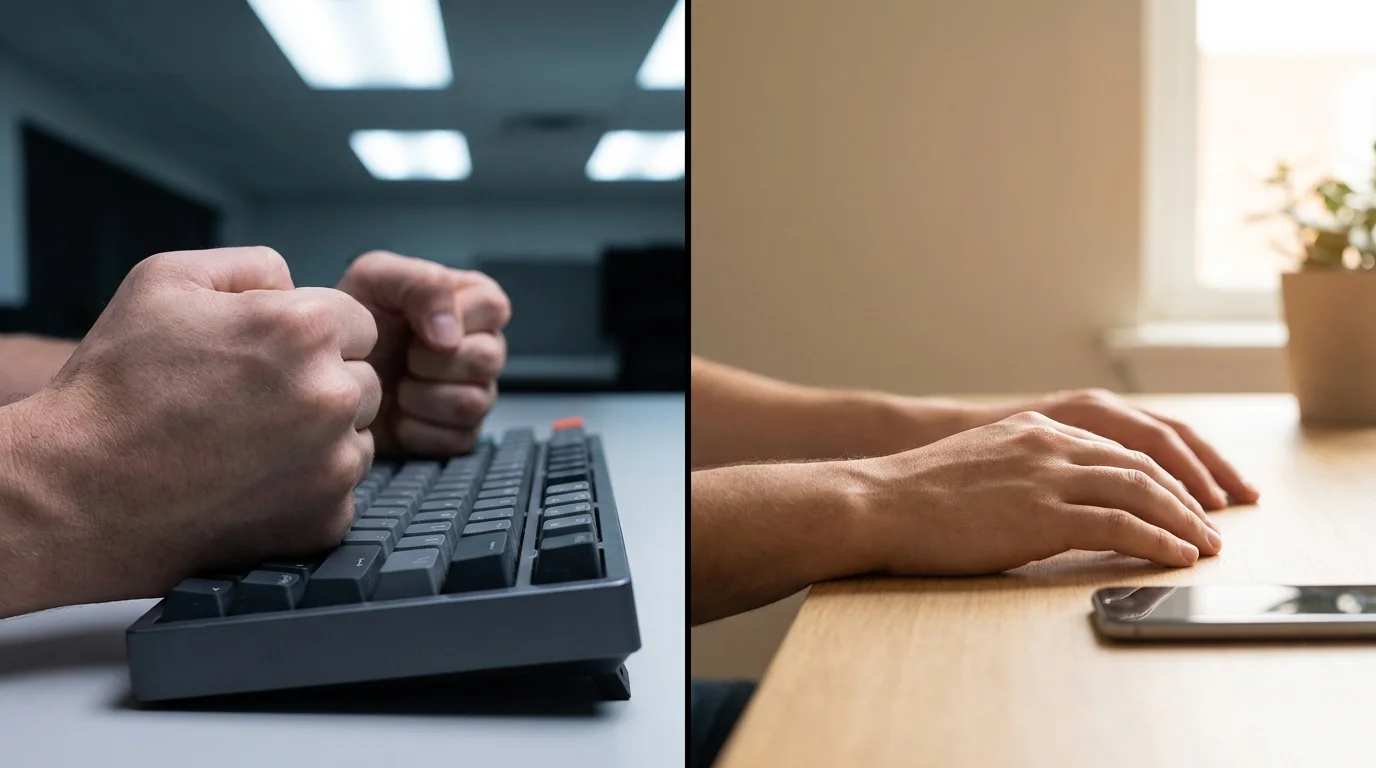 Traditional typing keeps inflamed RA joints under load all day. Voice dictation removes that load entirely.
Get Started with BossAI
For RA patients, the most important feature a dictation tool can have is complete hands-free operation — no cleanup typing, no switching apps, no hidden return to the keyboard. BossAI handles transcription, filler removal, grammar, and formatting in a single real-time pass, so output is ready the moment you stop speaking.
Not ready to switch yet? Get Our AI Productivity Guide — free strategies for hands-free workflows built for people who need to write without typing.
Frequently Asked Questions
Does typing aggravate rheumatoid arthritis?
Yes. Repetitive keyboarding loads the metacarpophalangeal joints and flexor tendons that RA attacks through synovial inflammation. Research confirms RA patients develop compensatory typing styles that reduce productivity and increase joint stress — and during active flares, keyboard use can accelerate local inflammation in the affected finger joints.
Is voice dictation safe for people with RA?
Voice dictation is the safest text input method for RA patients — it requires no hand contact with any device. AI dictation tools like BossAI transcribe, format, and correct speech output automatically, eliminating the cleanup typing that basic voice-to-text tools require. It's recommended by occupational therapists as the primary hands-free alternative to keyboard use.
Is BossAI useful for people with rheumatoid arthritis?
BossAI is a fully hands-free AI keyboard available on iOS, Android, macOS, and Windows. It removes filler words, corrects grammar, and formats text automatically so no cleanup typing is needed after dictating. The free tier provides 500 words per day with a daily reset — not a weekly cap — which accommodates the unpredictable flare cycles typical of RA without burning through a week's allowance on a bad day.
What ergonomic keyboard is best for RA?
Split keyboards (such as the Kinesis Freestyle or Logitech ERGO K860) reduce ulnar deviation in RA-affected wrists. Low-actuation keys (under 45g force) lessen per-keystroke strain on finger joints. Combined with a palm rest, they redistribute typing load — though they don't eliminate it — and voice dictation provides more joint protection than any hardware modification for significant hand involvement.
Can RA progress from typing?
Typing alone doesn't cause RA progression — RA is immune-driven, not mechanical in origin. However, repetitive joint loading during active inflammation can worsen local joint damage over time. Occupational therapists treating RA patients consistently recommend reducing repetitive fine motor tasks, including keyboard use, during flares — and building structured rest protocols to protect long-term joint integrity.