

Dictate a Book: How Writers Draft Faster & Cleaner | BossAI
Dictate a Book: How Writers Draft Faster by Talking, Not Typing
Every dictation tool has a lag between when you stop talking and when clean text shows up on the page. Most sit somewhere between one and three seconds. BossAI's real-time transcription plus its 300-millisecond AI enhancement step closes that gap enough that writers can dictate a book the same way they'd talk through a scene out loud — without staring at a spinner.
That speed changes what dictation is for. It stops being a fallback for people who can't type and becomes a faster way to draft for anyone who can talk faster than they type.
Why Writers Dictate a Book Instead of Typing It
For most of the last decade, dictation software was pitched at two groups: people with RSI or hand injuries, and people who genuinely couldn't type. Everyone else typed, because early dictation tools produced text that needed a full editing pass just to be readable.
That's no longer the constraint. Modern AI-enhanced dictation removes filler words, fixes grammar, and formats sentences as you speak — not after you upload a recording. Writers who dictate a novel today aren't settling for a rough transcript; they're getting a working draft.
The result is a growing group of novelists, screenwriters, and podcasters who choose voice typing for writers as their default drafting method, not their backup plan. Custom dictation instructions let them lock in formatting rules once — chapter headers, dialogue punctuation, capitalization — so every session comes out consistent.
Can You Really Dictate a Book, Start to Finish?
Yes — full-length manuscripts are regularly dictated start to finish, using AI dictation tools that clean up speech in real time rather than leaving a raw transcript to edit later. The limiting factor isn't the technology; it's whether a writer can think out loud in scenes and sentences instead of typed fragments. That's a habit, not a hardware requirement.
Raw transcription tools — the kind built for meeting notes — still leave "um," "uh," and half-finished sentences in the text. That's fine for a meeting summary. It's not fine for a manuscript you're trying to draft in real time.
Worth knowing: BossAI removes filler words and polishes sentence structure in about 300 milliseconds after you stop speaking — the text you see is close to publication-ready, not a transcript you have to clean up first.
Writers who narrate a book from outline to first draft describe the same shift: the bottleneck moves from "how fast can I type" to "how well do I know the scene I'm about to describe."
Why Professional Authors and Screenwriters Choose Voice Dictation
Dictation isn't a fringe habit among working writers. Screenwriters have used it for years to get dialogue-heavy scenes down at conversational speed, and a growing number of novelists now draft entire books by talking through chapters on walks or during commutes.
The appeal is less about typing speed and more about staying in flow. Talking through a scene mirrors how most writers actually think about it — as dialogue and action, not as a sequence of keystrokes. Breaking that flow to type slows down the exact thinking that makes a scene work.
Genre fiction writers, in particular, have leaned into this. Voice-to-text novel writing is disproportionately common among thriller and romance authors — genres that reward volume and a strong ear for dialogue, both of which favor speaking over typing.
How Much Faster Is Dictating a Book Than Typing?
Most people speak at 120–150 words per minute in normal conversation, compared to 35–45 words per minute for average typing speed — roughly three to four times faster. Even accounting for pauses to think through a scene, dictating a chapter typically takes a fraction of the time typing the same chapter would.
| Method | Typical Speed | Words in a Focused 60-Minute Session |
|---|---|---|
| Typing (average writer) | 35–45 WPM | ~2,000–2,500 |
| Typing (fast touch typist) | 60–80 WPM | ~3,500–4,500 |
| Dictating (conversational pace) | 120–150 WPM | ~6,000–8,000 |
Those numbers assume steady output, which real drafting sessions rarely are — typing or dictating. The gap still holds up in practice. Writers who've fully switched to dictation regularly report 2,000+ words a day without a marathon typing session to show for it.
What Editing a Dictated Draft Actually Looks Like
Editing dictated text is different from editing typed text, but it isn't harder. The first pass usually catches structural issues — a scene that meanders, a paragraph that repeats a point — the same edits any first draft needs.
The second pass is where AI-cleaned dictation pulls ahead of raw transcription. Filler words and false starts are already gone, so editors spend their time on story problems instead of stripping "so anyway" and "I guess" out of every paragraph.
For proofreading, many writers dictate the draft, then listen back to check pacing and dialogue rhythm before a human edit — a voice book reader can narrate the finished draft back to you for exactly that kind of pass. Others prefer to dictate on a voice-to-text app for Mac during drafting, then switch to a keyboard for line edits.
Getting your own voice and formatting habits consistent from session to session matters here. Custom instructions — never using em dashes, always writing in a specific tense, formatting dialogue a certain way — mean less cleanup on every chapter.
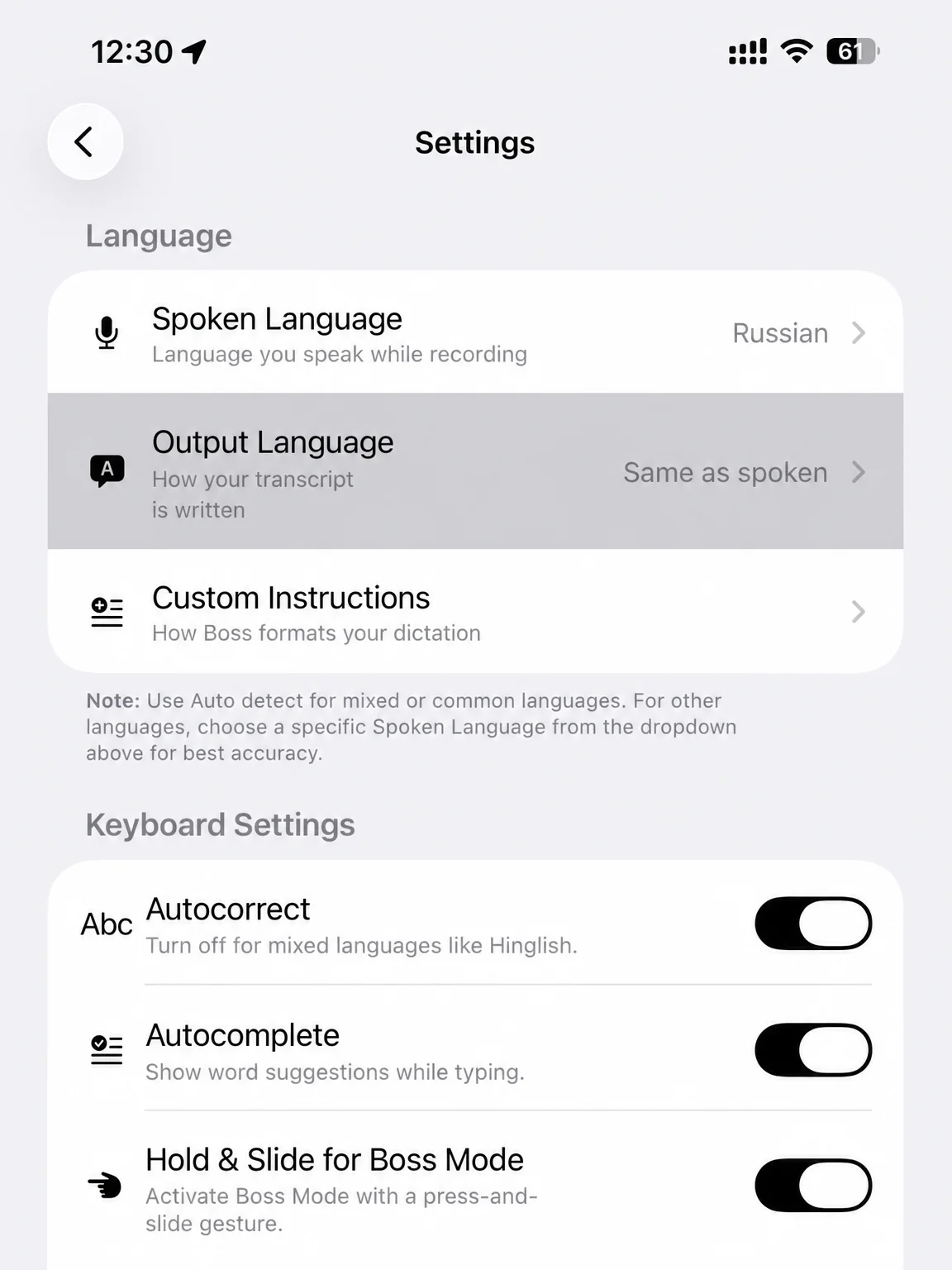 Spoken language, output language, and custom instructions all live in one settings screen.
Why Writers Are Switching to Voice Dictation
The writers moving to dictation aren't chasing a novelty. They're choosing a setup that matches their process: a spoken language selector, an output language independent of it, and custom formatting instructions that carry across every session.
That combination matters more for fiction than for email. A novelist drafting a bilingual character's dialogue, or a memoirist switching between English and their first language mid-chapter, needs a tool that tracks context automatically instead of forcing a manual language switch every time.
BossAI's real-time transcription and 300ms AI enhancement handle that switch without breaking the sentence you're mid-way through speaking — the difference between dictation that fits a writing habit and dictation that fights it. Set the spoken language, output language, and custom instructions once, and every session afterward matches your voice automatically.
Capturing Ideas Without Breaking Your Dictation Flow
The hardest part of a long dictation session isn't the drafting — it's the interruptions. A character name you want to reuse. A chapter header format. A line of dialogue you thought of in the shower and don't want to lose before you sit down to write.
Clips solve a narrower problem than dictation itself, but it's a real one for writers: saving short, frequently reused text — character names, chapter header formats, recurring phrases — and pasting them from the keyboard without opening a notes app.
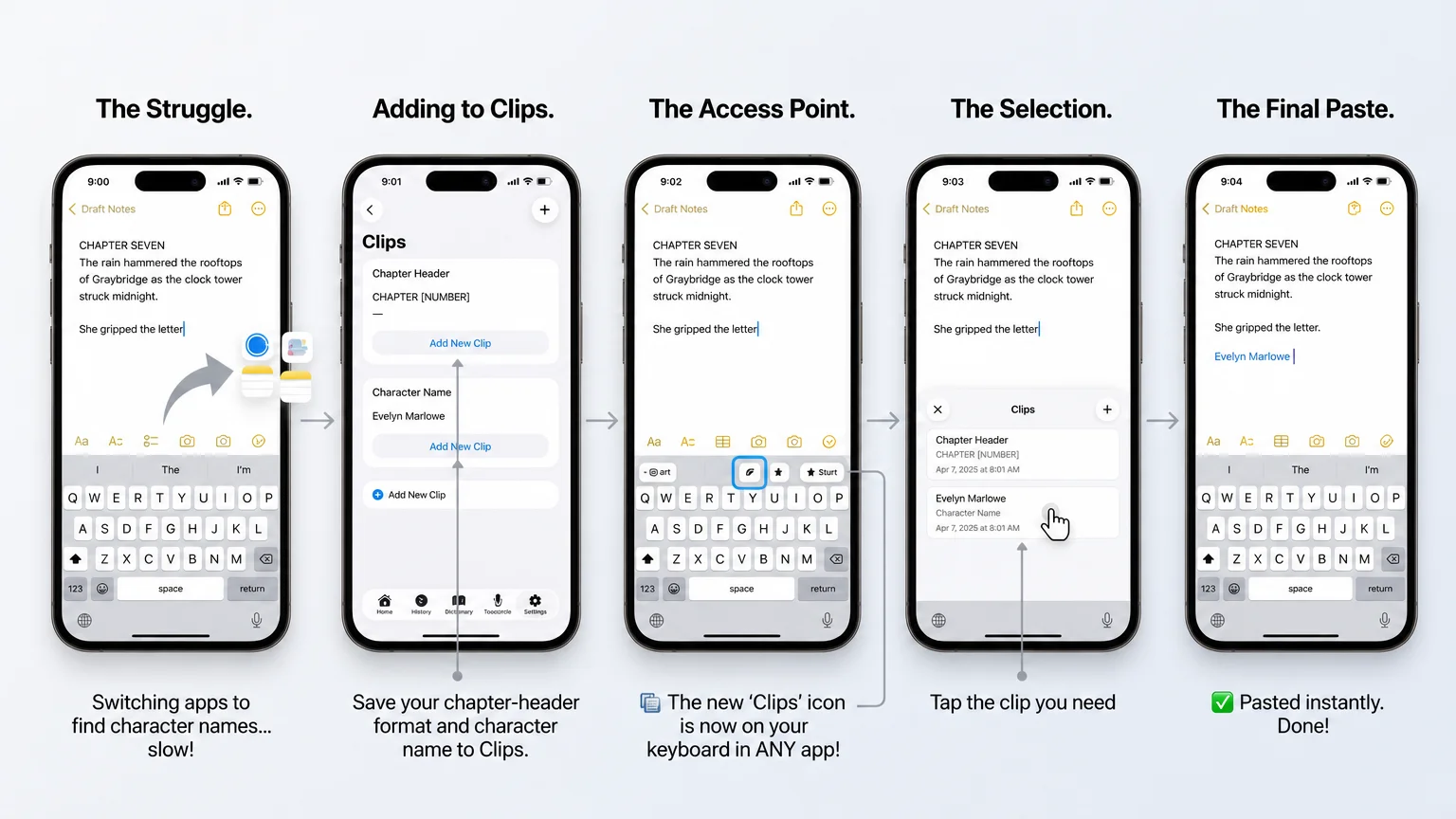 Clips save a recurring line once and paste it from the keyboard in any app afterward.
For a novelist, that might mean a saved chapter-header format, a recurring character description, or a working title that changes every draft. For a nonfiction writer, it's often citation formats or standard section headers. Either way, the app you're dictating in never changes.
Which Dictation Tool Fits Long-Form Writing Best?
The best dictation software for writers is the one that cleans up speech in real time, supports the languages and formatting a specific manuscript needs, and doesn't cap sessions in the middle of a chapter. Transcription-only tools built for recorded meetings, and read-aloud tools built for consuming text, solve different problems than drafting one.
Still deciding between tools? What is the best dictation AI covers the broader comparison across categories in more depth. Writers on Windows machines should also check dictation software for Windows for platform-specific setup notes.
The short version: match the tool to the writing, not the other way around. A tool built for meeting transcripts will always feel like it's fighting a manuscript.
Quick Recap
- Professional authors regularly dictate 2,000+ words a day using AI-enhanced voice-to-text — no typing required for the first draft.
- BossAI removes filler words automatically and polishes dictated text in about 300 milliseconds, so the output is close to publication-ready as you speak.
- Speaking runs roughly three to four times faster than typing (120–150 WPM vs. 35–45 WPM), which is where most of the time savings comes from.
- Custom instructions and automatic language tracking keep formatting and voice consistent across every dictation session, in any language.
- Clips remove the need to break flow for recurring text — character names, chapter headers, and reused phrases paste instantly from the keyboard.
Get Started with BossAI
If talking through a scene comes more naturally to you than typing it, dictating a book is worth trying as your primary drafting method, not a fallback. Download BossAI Free and dictate your next chapter to see what real-time cleanup does to your draft.
Not ready to try it yet? Get Our AI Productivity Guide — free tips on working faster with AI.
FAQ
Can dictation software really replace typing for an entire manuscript?
Yes. AI-enhanced dictation tools clean up speech into readable, formatted text in real time, so a full manuscript can be drafted by voice from the first chapter to the last. The main requirement is comfort thinking through scenes out loud rather than typed fragments.
Do professional authors and screenwriters actually use voice dictation?
Yes — dictation has moved well beyond an accessibility tool. Screenwriters have long used it for dialogue-heavy scenes, and a growing share of novelists, especially in fast-paced genres, now draft most of their books by talking through chapters instead of typing them.
What platforms does BossAI run on for writers who dictate across devices?
BossAI works on iOS, Android, macOS, and Windows, replacing the default keyboard on mobile and running as a background app on desktop. A writer can dictate a chapter on a laptop, then continue drafting notes on a phone without switching tools.
Is BossAI accurate enough for long dictation sessions?
BossAI's speech recognition performs well in quiet environments and handles accented speech reliably, removing filler words and correcting grammar as you speak. That real-time cleanup produces noticeably cleaner text than built-in options like Apple Dictation straight out of the box.
How do you keep formatting consistent across a whole book dictated in separate sessions?
Custom instructions saved once — tense, punctuation style, chapter header format — apply automatically to every future dictation session. Combined with automatic language tracking, this keeps a manuscript's voice and formatting consistent across dozens of separate sessions.