

Can Typing Cause Carpal Tunnel Syndrome? | BossAI
Can Typing Cause Carpal Tunnel Syndrome? What the Research Shows
Most people who search "can typing cause carpal tunnel syndrome" are already dealing with tingling fingers, not researching out of curiosity. By the time the question comes up, symptoms have usually been building for months. Carpal tunnel syndrome doesn't announce itself — it accumulates, quietly, keystroke by keystroke.
Key Takeaways
- Research on typing and carpal tunnel syndrome is mixed: one controlled study found active typing raises carpal tunnel pressure by an average of 0.53 kPa above resting levels, but Mayo Clinic notes the stronger evidence points to mouse use over keyboard use alone.
- Wrist posture matters more than raw typing volume — pressure spikes sharply once wrist extension passes roughly 30 degrees, the exact position most people fall into typing on a laptop.
- Early signs (finger tingling, nighttime numbness, wrist pain after typing sessions) are the best window to intervene before nerve damage becomes permanent.
- Carpal tunnel syndrome affects an estimated 3% to 6% of adults, making it the most common nerve compression disorder.
- Voice typing removes the repetitive wrist motion entirely — it doesn't just reduce keystrokes, it eliminates the mechanical stress research ties to elevated carpal tunnel pressure.
Contents
- Can Typing Cause Carpal Tunnel Syndrome?
- What Is Carpal Tunnel Syndrome, Exactly?
- What Are the Early Warning Signs of Typing-Related Carpal Tunnel?
- How Much Daily Typing Increases Your Carpal Tunnel Risk?
- What's the Best Way to Prevent Carpal Tunnel From Typing?
- How Voice Typing Prevents Carpal Tunnel
- Is Voice Typing Safe if You Already Have Carpal Tunnel?
- Can You Recover From Carpal Tunnel Caused by Typing?
Can Typing Cause Carpal Tunnel Syndrome? What the Evidence Shows
The research is genuinely mixed. A controlled study measuring carpal tunnel pressure during active typing found it rises by an average of 0.53 kPa above static rest, and pressure climbs further as wrist extension increases — but Mayo Clinic points to mouse use, not keyboard typing alone, as carrying the stronger evidence link. Neither claim cancels the other out; they describe different mechanisms.
What the data agrees on is this: the carpal tunnel is a narrow passage in the wrist, and anything that raises pressure inside it — sustained wrist extension, repetitive finger flexion, poor positioning — puts the median nerve at risk over time. Typing is one contributor among several, not a guaranteed cause.
That nuance gets lost in a lot of health content, which tends to flatten "typing causes carpal tunnel" into a blanket fact or dismiss it entirely. Neither extreme matches what researchers actually measured.
Reality check: Typing alone, at a neutral wrist angle, produces a modest pressure increase. Typing with a bent-up wrist for eight hours a day is a different risk profile entirely — posture is doing most of the damage, not the keys.
What Is Carpal Tunnel Syndrome, Exactly?
Carpal tunnel syndrome happens when the median nerve — which runs from your forearm into your hand through a narrow passage of bone and ligament in the wrist — gets compressed. That compression produces the tingling, numbness, and weakness people associate with the condition, usually concentrated in the thumb, index, middle, and part of the ring finger.
It's common. An estimated 3% to 6% of adults deal with it at some point, making it the most frequently diagnosed nerve compression disorder in the U.S. The carpal tunnel itself is fixed in size — it can't expand to accommodate swelling, which is exactly why repeated strain becomes a problem instead of just discomfort.
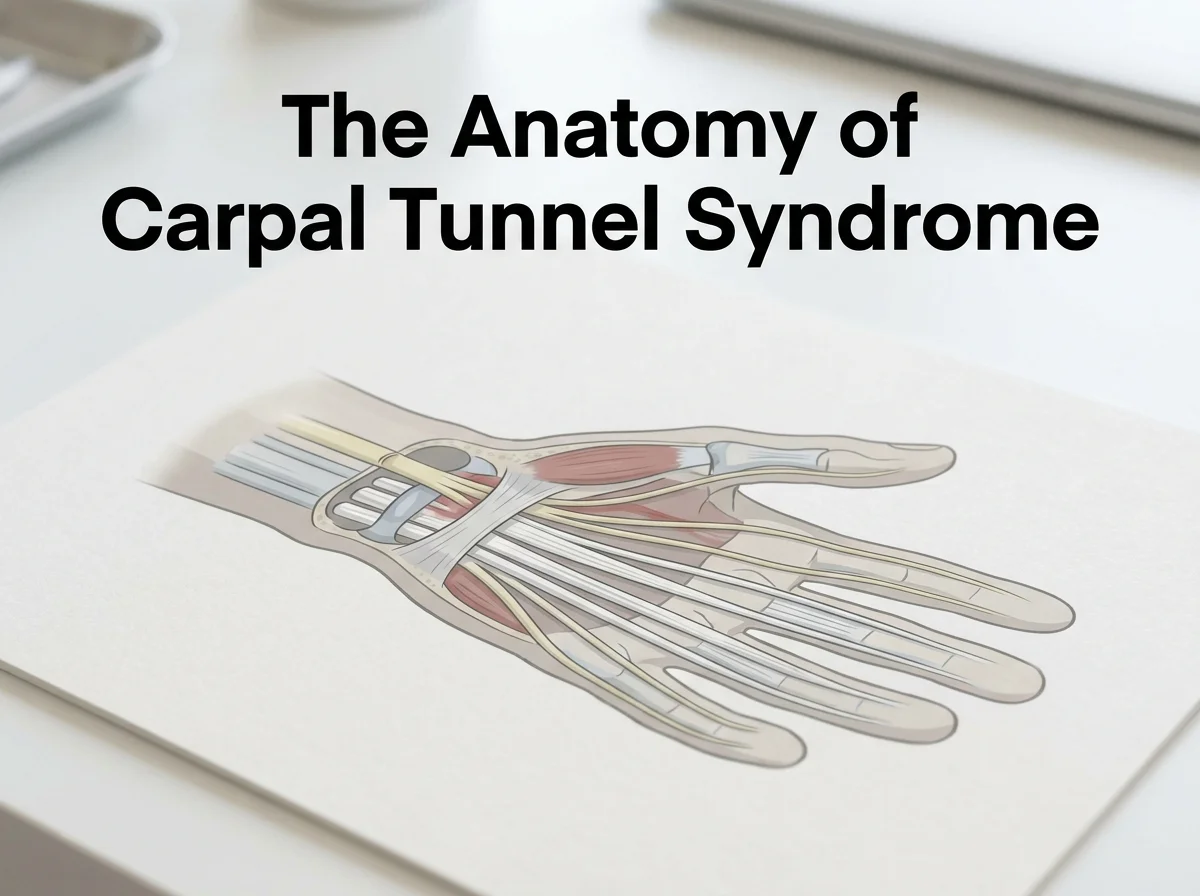 The median nerve travels through a fixed-size passage — any added pressure has nowhere to go.
Several things can narrow that passage further: fluid retention, thyroid conditions, diabetes, pregnancy, and — relevant here — repetitive hand and wrist motion. Typing sits in that last category, alongside activities like assembly line work, playing certain instruments, and prolonged tool use.
What Are the Early Warning Signs of Typing-Related Carpal Tunnel?
The earliest signs are usually intermittent: tingling in the thumb and first two fingers, a dull ache in the wrist after a long typing session, or numbness that wakes you up at night. These symptoms often disappear after a break, which is exactly why people ignore them until they stop going away.
Left unaddressed, symptoms tend to escalate in a fairly predictable order:
- Occasional tingling or "pins and needles" during or after typing
- Wrist or forearm soreness that lingers past the workday
- Numbness that appears at night, sometimes waking you up
- Weakened grip strength — dropping small objects, struggling to open jars
- Difficulty distinguishing hot from cold by touch in severe cases
If any of this sounds familiar, it's worth reading through wrist hurts when typing — it covers the broader set of causes behind wrist pain, since carpal tunnel is only one of several possibilities.
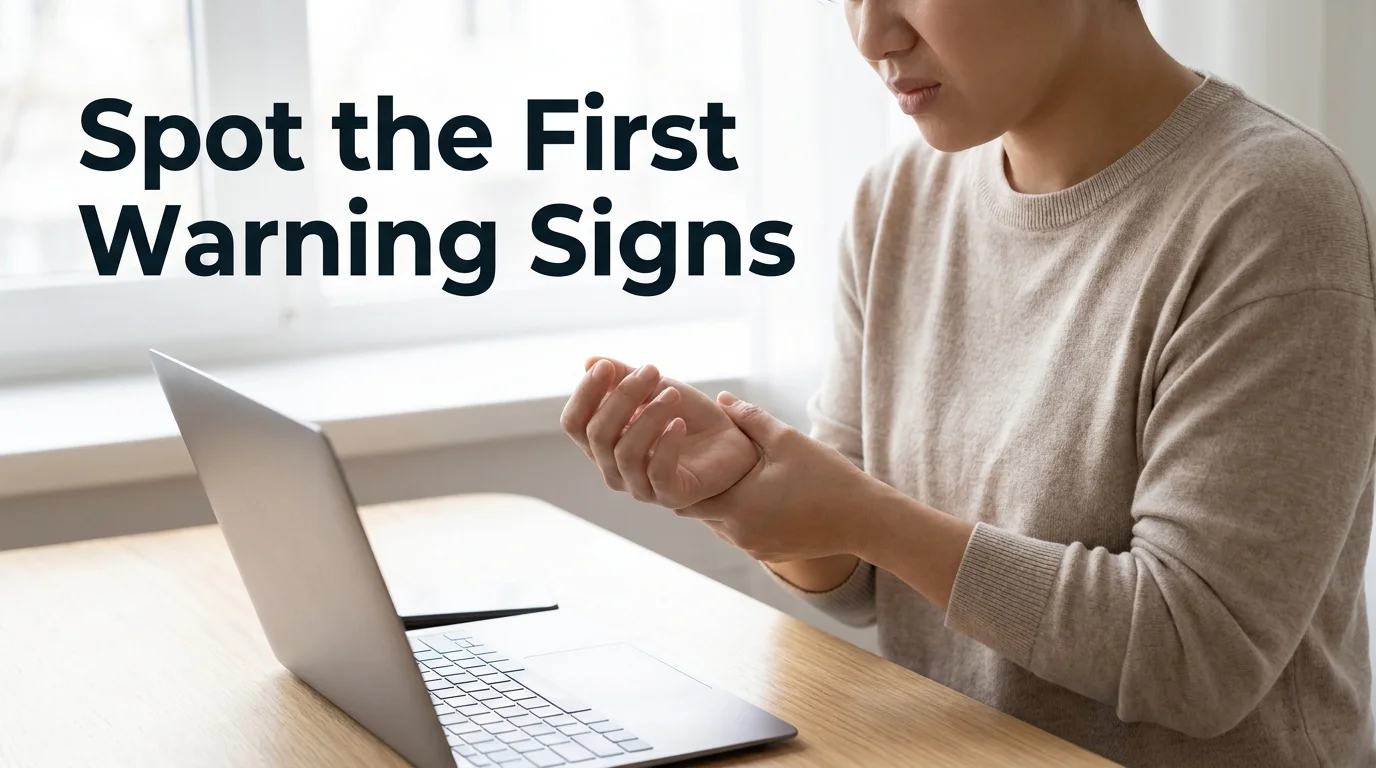 Symptoms that fade after a break in the early stages tend to return more frequently as compression continues.
Worth knowing: Nighttime numbness is one of the most specific early markers for carpal tunnel specifically — most people sleep with wrists flexed, which increases pressure on the median nerve even though no typing is happening.
How Much Daily Typing Increases Your Carpal Tunnel Risk?
Duration matters, but posture appears to matter more. In the controlled pressure study referenced earlier, researchers found that wrist extension beyond roughly 30 degrees and radial deviation beyond 15 degrees pushed carpal tunnel pressure toward the 4 kPa threshold where nerve conduction changes and tingling begin — a position most laptop typists land in without realizing it.
That's a meaningfully different risk model than "type for X hours and you're fine." Someone typing eight hours a day with a properly elevated external keyboard and neutral wrists carries less risk than someone typing three hours a day hunched over a laptop with wrists cocked upward. Volume is one variable in an equation dominated by angle.
For a deeper breakdown of causes, contributing data, and what actually predicts risk, carpal tunnel from typing walks through the fuller picture beyond what fits here.
What's the Best Way to Prevent Carpal Tunnel From Typing?
Ergonomic correction is the first line of defense: keep wrists neutral (not bent up or down), position the keyboard so elbows sit near 90 degrees, and take a break every 20 to 30 minutes to stretch. None of this is exotic advice, but consistency is what makes it work — a good setup used inconsistently doesn't protect you.
Practical steps that hold up across most prevention guides:
- Keep the keyboard and mouse at a height where wrists stay flat, not angled up or down
- Use a split or tented keyboard if standard layouts force wrist rotation
- Try a vertical mouse — some evidence suggests it reduces strain compared to traditional designs
- Stretch wrists and fingers for 15–30 seconds every half hour of typing
- Consider wrist support during long sessions — see carpal tunnel gloves for typing for what actually helps versus what's marketing
The short version: Ergonomics reduce risk. They don't eliminate the repetitive motion itself — that requires removing typing from the equation for at least part of your day.
How Voice Typing Prevents Carpal Tunnel
That last point is where dictation earns its place in a prevention plan rather than as a workaround. Voice typing doesn't optimize the wrist position during typing — it removes the repetitive keystrokes that create pressure in the first place.
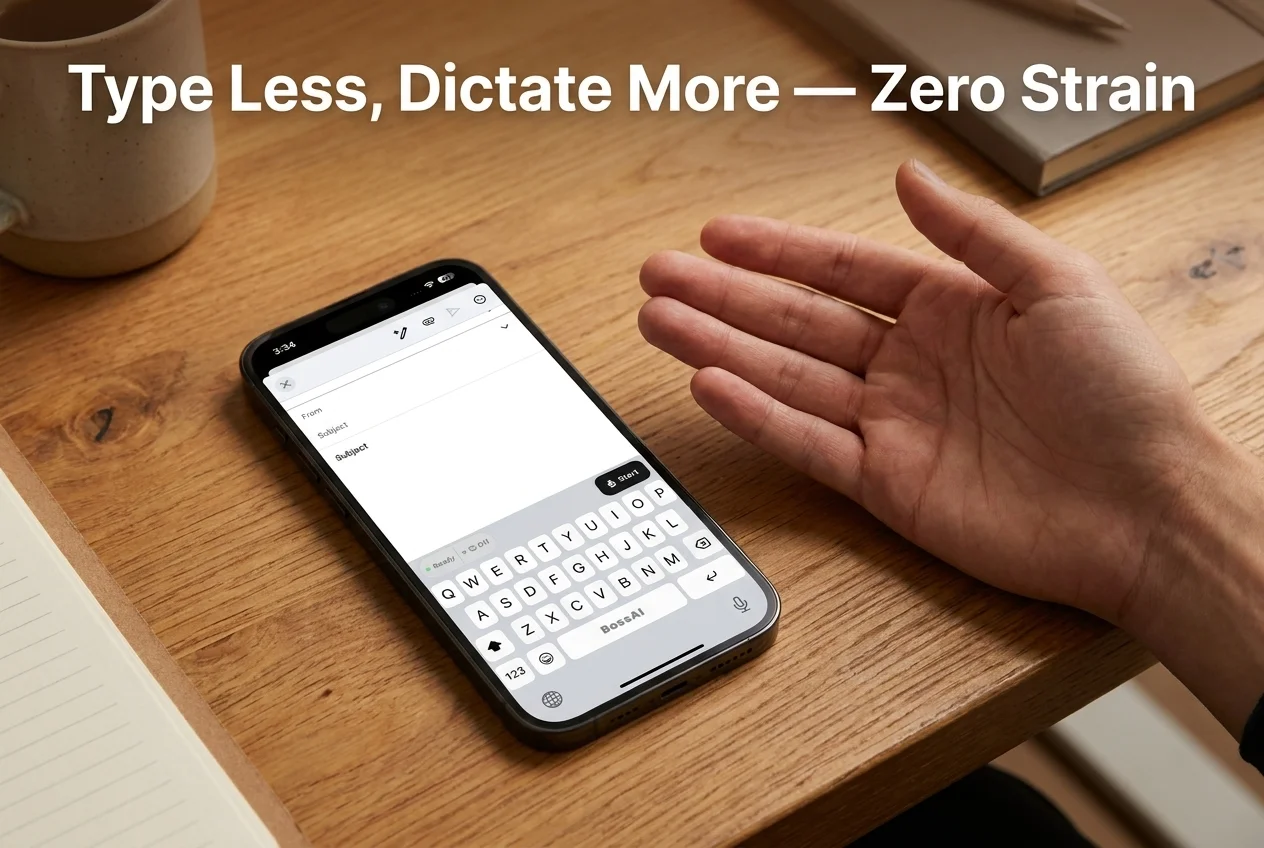 Dictating a message means the hand never engages the keyboard at all — no flexion, no extension, no accumulated pressure.
BossAI is an AI-enhanced voice keyboard for iOS, Android, macOS, and Windows that replaces typing with speech. You talk, it transcribes in real time, strips out filler words like "um" and "uh," fixes grammar, and formats the result for whatever app you're in — an email reads like an email, a text reads like a text, without you touching a single key.
A hundred-word email takes roughly 500 keystrokes to type by hand. Dictated through BossAI, it's under 30 seconds of speaking and zero hand motion. For people managing early carpal tunnel symptoms, that's not a productivity feature — it's the difference between finishing a workday in pain or not.
| Factor | Typing | Voice Typing (BossAI) |
|---|---|---|
| Wrist movement per 100 words | ~500 keystrokes, continuous flexion/extension | Zero — wrist stays at rest |
| Carpal tunnel pressure vs. static rest | +0.53 kPa average during active typing | No measurable increase |
| Repetitive strain source | Accumulates with duration and wrist angle | Removed at the source |
| Time for a 100-word email | ~2–3 minutes hunt-and-peck, ~40–60 sec touch typing | Under 30 seconds, auto-formatted |
| Hands-free operation | No | Yes, including screen-aware replies via Boss Mode |
BossAI's Boss Mode extends this further: say "Boss, reply to this email confirming Friday" and it reads the screen, understands the context, and writes the reply — no copy-pasting, no typing to set up the request in the first place.
Is Voice Typing Safe if You Already Have Carpal Tunnel?
Yes — voice typing is one of the few writing methods that adds zero mechanical load to an already irritated median nerve, since there's no keystroke or grip involved at all. BossAI in particular was built for exactly this kind of zero-keyboard use: dictate everything and it handles transcription, filler removal, and tone correction automatically, so users with RSI, carpal tunnel, or a wrist in a brace can still write emails and documents without a single tap.
This matters beyond desk workers, too. Medical professionals managing dictation-heavy documentation, and anyone recovering from a wrist injury who still needs to communicate for work, fall into the same category — voice becomes the only input method that doesn't aggravate the injury while it heals.
Can You Recover From Carpal Tunnel Caused by Typing?
Recovery timelines depend heavily on severity and how early you intervene: mild cases often resolve within a few weeks of rest, splinting, and ergonomic changes, while moderate-to-severe cases may need corticosteroid injections or surgery and take several months to fully heal. Catching symptoms in the tingling-and-soreness stage, before numbness becomes constant, is what keeps most cases in the "weeks" category instead of the "surgery" one.
During recovery, cutting keyboard use — not just correcting posture — tends to accelerate healing, since posture fixes reduce new strain but don't address the accumulated pressure already irritating the nerve. This is where voice typing does double duty: it's a genuine keyboard alternative during recovery, not just a prevention tool for people who haven't developed symptoms yet.
Get Started with BossAI
If typing has started to hurt, or you'd rather not find out the hard way, switching part of your daily writing to voice is a low-friction place to start. BossAI works across your phone, laptop, and desktop, so the switch doesn't mean relearning your workflow — just speaking instead of typing.
Not ready to try it yet? Get Our AI Productivity Guide — free tips on working faster with AI.
FAQ: Can Typing Cause Carpal Tunnel Syndrome and Other Common Questions
Can typing cause carpal tunnel syndrome?
Typing can contribute to carpal tunnel syndrome, but research is mixed on how much versus other factors like mouse use and wrist posture. A controlled study found active typing raises carpal tunnel pressure measurably, with posture — not just duration — playing the larger role in overall risk.
What are the first signs of carpal tunnel from typing?
The earliest signs are usually intermittent tingling in the thumb, index, and middle fingers, wrist soreness after typing sessions, and numbness that shows up at night. These symptoms often fade with rest early on, which is why they're easy to dismiss until they become constant.
How long does it take to develop carpal tunnel from typing?
There's no fixed timeline — it depends on wrist posture, hours typed, and individual anatomy far more than a simple hour count. Someone typing with wrists bent upward for a few hours daily can develop symptoms faster than someone typing longer with a neutral, properly supported setup.
Does BossAI help with carpal tunnel or wrist pain from typing?
Yes. BossAI is built for zero-keyboard use — you dictate everything and it handles transcription, filler removal, and tone correction automatically. People managing carpal tunnel, RSI, or a wrist injury use it to write emails, messages, and documents entirely hands-free, without typing a single word.
Can carpal tunnel from typing heal on its own?
Mild cases can improve with rest, wrist splinting, and reduced keyboard use, especially when caught early. Moderate-to-severe cases usually need more active treatment — corticosteroid injections or surgery — because the nerve compression doesn't resolve through rest alone once it's advanced.
What's the fastest way to relieve carpal tunnel pain from typing?
Short term, a wrist splint (especially at night) and immediately reducing typing volume relieve pressure fastest. Longer term, correcting wrist posture and replacing part of your typing with voice dictation addresses the repetitive strain that caused the pain in the first place.