
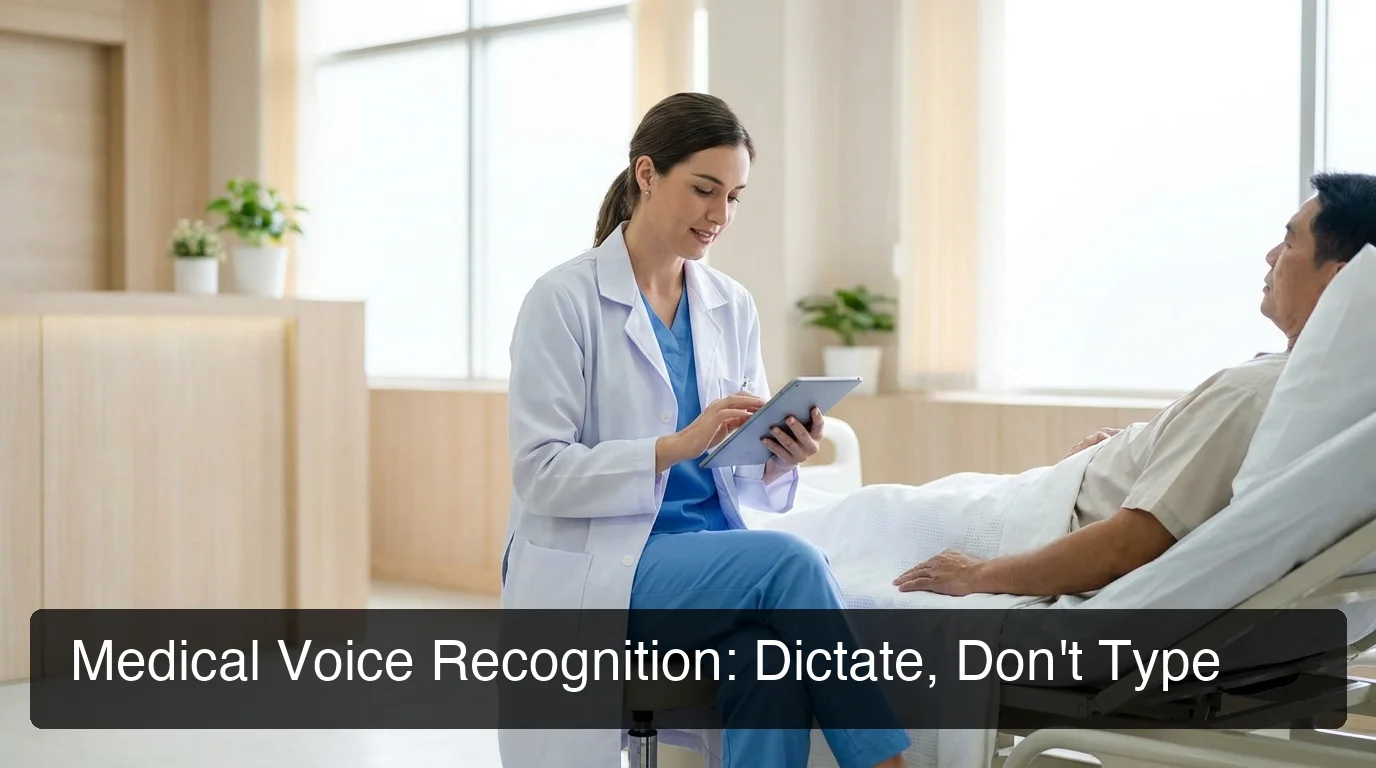
Medical Voice Recognition Software: 2026
Medical voice recognition software converts spoken clinical language into structured healthcare documentation — in real time, inside any app or EHR. These tools are trained on specialized medical vocabulary that consumer dictation apps don't have, and built with the compliance architecture required for handling patient data. Physicians spend an average of 2.2 hours per day on EHR entry; most users of medical voice recognition cut that by 30–40% within the first month.
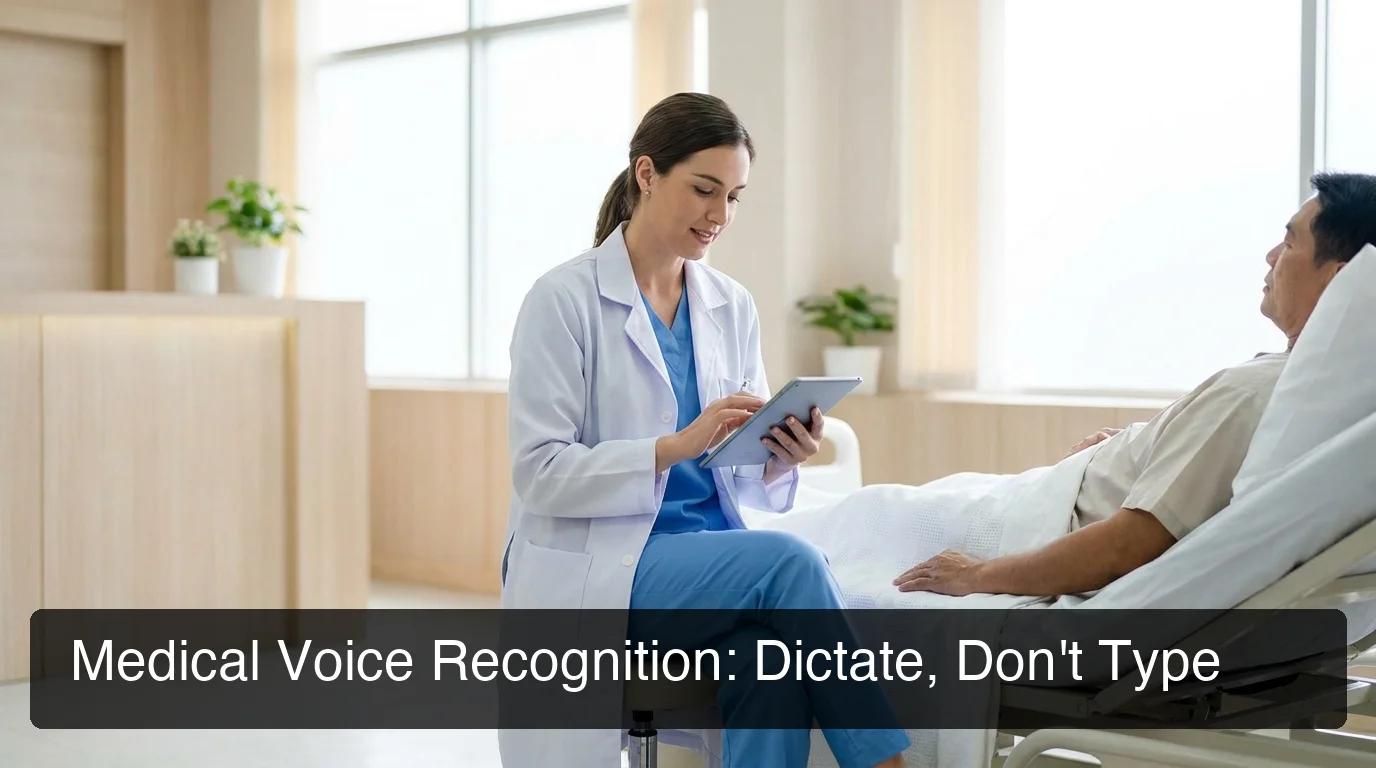 Medical voice recognition turns spoken observations into structured notes — without interrupting patient interaction.
How Does Medical Voice Recognition Software Differ From General Dictation Apps?
Medical voice recognition software is trained on 300,000+ clinical terms — drug names, diagnoses, procedures, anatomical references — that consumer apps don't recognize. Standard tools like Apple Dictation or Google voice typing transcribe everyday speech accurately but regularly misidentify medical terminology, producing errors that require manual review and eliminate any time saved.
Consumer apps weren't designed for clinical accuracy. "Metoprolol" becomes "met a prolol." "HEENT normal" becomes something unrecognizable. The output might be close enough for a text message, but clinical documentation requires precision — a transcription error in a note isn't just an inconvenience, it can affect treatment decisions and legal records.
Medical-grade tools address this at the vocabulary layer. They're pre-trained on clinical corpora and allow providers to add institution-specific terms, local drug formularies, and referring physician names. The difference in usability compared to general speech recognition apps isn't marginal — it's categorical for clinical workflows.
Worth knowing: The accuracy gap is one part of the problem. Consumer apps also process audio on general-purpose infrastructure with no healthcare compliance requirements, while medical voice tools build HIPAA controls into how audio is processed and discarded — a structural difference, not just a setting.
Key Takeaways
- Medical voice recognition reduces physician documentation time by 30–40%, recovering hours each week for direct patient care
- HIPAA compliance in voice tools means encrypted transit, zero data retention post-transcription, and a Business Associate Agreement (BAA) — consumer apps offer none of these
- Professional-grade software costs $8–$30/month; ROI comes fast through faster charting, eliminated hand fatigue, and fewer correction cycles
- Accuracy depends on clinical vocabulary training — the tool must recognize drug names, procedures, and medical terminology to be viable without review
- Screen-aware tools like BossAI read your EHR interface and generate contextual documentation without copy-pasting
Related: Cloud Based Dictation: What It Is & How to Choose
Contents
- How Does Medical Voice Recognition Software Differ From General Dictation Apps?
- Which Healthcare Professionals Use Voice Recognition Software?
- Why Is Accuracy Critical in Medical Voice Recognition Software?
- How Does HIPAA Compliance Work in Voice Recognition Tools?
- Why Doctors Are Switching to Voice Recognition Software
- How Much Does Medical Voice Recognition Software Cost?
- Can Consumer Apps Like Siri Handle Medical Documentation?
Which Healthcare Professionals Use Voice Recognition Software?
Medical voice recognition is used across specialties — physicians, radiologists, nurses, physical therapists, and mental health professionals all document faster with it. Any role requiring structured written output from spoken clinical observations benefits, but adoption is highest where typing most visibly interrupts direct patient contact.
Radiologists adopted voice recognition earlier than most. Dictating imaging reports became standard practice in large radiology departments long before AI-powered transcription arrived. Primary care physicians use it for SOAP notes and visit summaries. Mental health providers document session observations, treatment plans, and progress notes.
Emergency medicine offers the clearest ROI calculation: short patient encounters, dense documentation requirements, and 20–40 patients per shift. Any per-note time savings compounds fast.
Why Is Accuracy Critical in Medical Voice Recognition Software?
A 2% word error rate in medical voice recognition software is clinical liability, not an inconvenience. That rate produces one misidentified term per 50 words — and in documentation covering medication names, procedures, and diagnoses, those errors affect treatment decisions, billing codes, and legal records. Consumer apps transcribing clinical speech at general-purpose accuracy aren't viable without heavy post-review.
A consumer app that misreads 2% of words is functional for everyday use. In a clinical note, the same error rate means one incorrectly transcribed medication name, procedure, or diagnosis per 50 words — a documentation problem that defeats the time-saving purpose.
Dragon Medical One has historically cited 99% accuracy for trained users on medical terminology. AI-native platforms like Nuance DAX and DeepScribe target real-time accuracy without manual correction. At these accuracy thresholds, documentation becomes review-and-confirm rather than transcribe-and-edit — a genuinely different workflow.
 At 99% accuracy, voice-first documentation eliminates the post-transcription editing loop entirely.
The risk is highest for phonetically similar drug names: "Zantac" vs "Xanax," "Celexa" vs "Celebrex." Consumer apps resolve these phonetically. Medical tools use clinical context training to identify the correct term.
How Does HIPAA Compliance Work in Voice Recognition Tools?
HIPAA-compliant medical voice recognition software processes patient audio on encrypted infrastructure without retaining identifiable data after transcription. Compliant vendors sign a Business Associate Agreement (BAA), implement access controls, encrypt audio in transit, and discard recordings immediately. Without a BAA, a voice tool cannot legally process protected health information.
The most critical question isn't whether audio is encrypted — that's baseline. The question is what happens to audio after transcription completes. Many consumer apps process voice to improve their models, which constitutes storing protected health information without authorization when patient content is included.
Zero-retention architectures process audio in real time and discard it immediately. No recordings stored, no data used for training, no audit trail of patient speech. For independent practitioners who can't afford enterprise compliance contracts, tools with built-in zero-retention provide the same legal protection at consumer pricing.
Why Doctors Are Switching to Voice Recognition Software
Typing into an EHR while maintaining eye contact with a patient is a physical impossibility. Voice documentation lets providers observe and engage continuously — capturing findings as they appear, not during charting time after the visit.
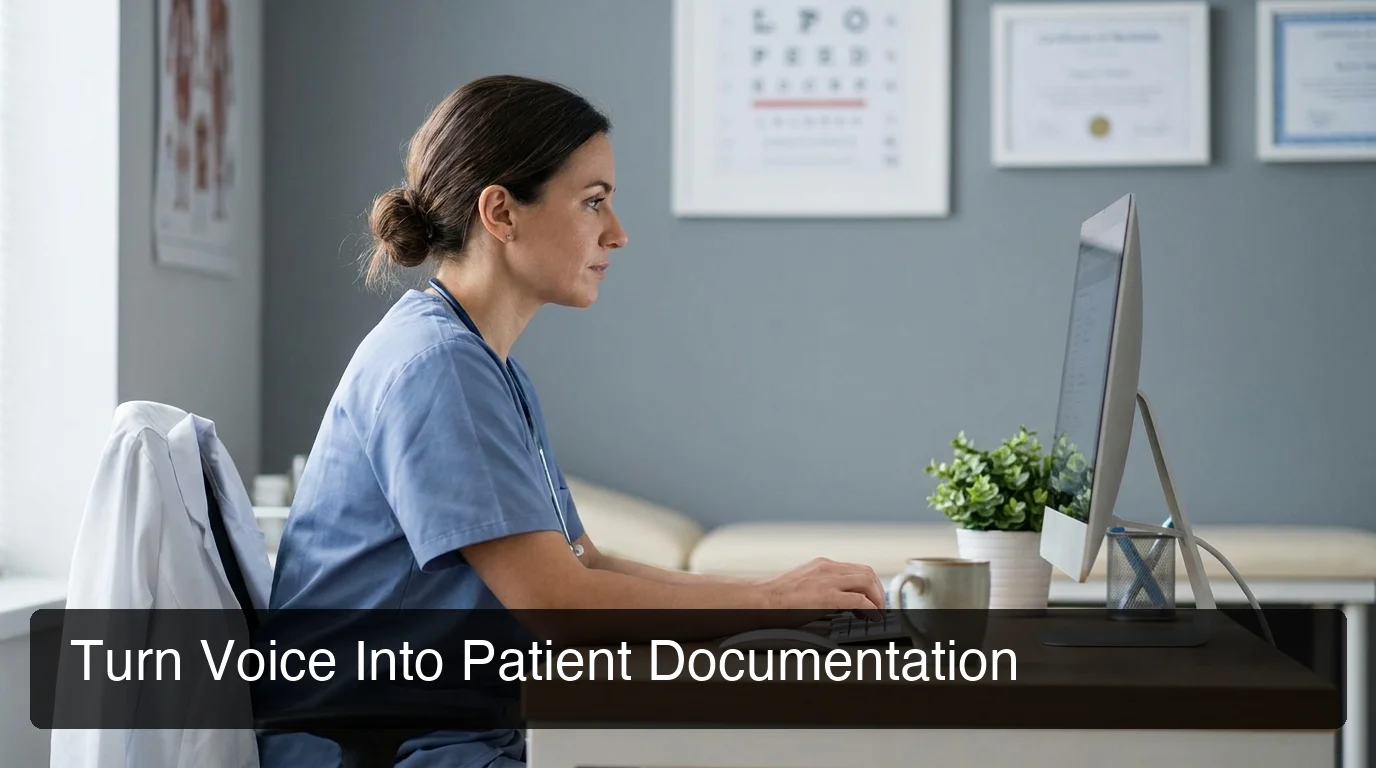 BossAI's Boss Mode reads what's on screen — including open patient records — and generates documentation from that context.
BossAI fills a gap in the market: voice dictation that doesn't store your audio or text, without enterprise pricing. Its free tier provides 500 words/day for voice documentation with zero data retention — audio is processed in real time and immediately discarded. Pro access at $9.99/month gives unlimited transcription under the same privacy standard.
Unlike tools that require EHR-specific integrations to understand context, BossAI's Boss Mode reads what's visible on your screen — including the open patient record — and generates documentation that reflects it. That eliminates the manual copy-paste loop between apps.
For a broader breakdown of specific platforms and enterprise options, the medical dictation software guide covers the full tool landscape across specialties and workflow types.
How Much Does Medical Voice Recognition Software Cost?
| Tool | Monthly | HIPAA | Notes |
|---|---|---|---|
| Dragon Medical One | ~$99 | BAA included | Legacy standard, high accuracy |
| Nuance DAX | Custom | BAA included | AI ambient documentation |
| BossAI | Free (500w/day) · $9.99 | Zero retention | Cross-platform, screen-aware |
| Willow Voice | $15 ($10 annual) | Enterprise tier | Team + individual plans |
| Superwhisper Pro | ~$8 | Self-managed | Local model, no BAA |
Enterprise platforms anchor the high end at $99+/month. Mid-tier options run $8–$15. ROI is fast at any price point: 30 minutes of documentation time saved daily equals 15 hours per month — more than half a clinical day recovered over a year.
The best speech to text software guide offers useful context if you're evaluating whether a medical-specific tool is required for your workflow versus a general-purpose option.
Can Consumer Apps Like Siri Handle Medical Documentation?
Siri, Google voice typing, and general AI tools like ChatGPT or Otter are not safe for medical documentation. They lack clinical vocabulary training, produce errors on drug names and procedures, and — critically — do not meet HIPAA requirements. Apple and Google retain audio for model improvement; including patient content in any dictation constitutes handling protected health information without authorization.
The practical boundary: consumer tools are fine for personal productivity — drafting non-clinical communications, setting reminders, capturing personal observations. Any dictation involving patient identifiers, diagnoses, or care plans requires a tool with explicit HIPAA compliance documentation and, ideally, a signed BAA.
BossAI does not store voice or text data on its servers on any platform — iOS, Android, macOS, or Windows — so the same privacy approach follows you across devices.
Start Documenting by Voice
EHR entry doesn't have to consume 2+ hours of your clinical day. Medical voice recognition software turns that time back into patient interaction — and HIPAA-safe options now exist at every price point.
BossAI's free tier includes 500 words/day of voice transcription with zero data retention. No enterprise contract, no complex setup.
Not ready to commit yet? Get Our AI Productivity Guide — practical tips on faster documentation without more typing.
Frequently Asked Questions
Is medical voice recognition software HIPAA-compliant?
Purpose-built medical voice recognition tools include HIPAA-compliant infrastructure: encrypted audio transit, zero or limited data retention, and Business Associate Agreements for healthcare providers. Consumer tools — Apple Dictation, Google voice typing, Otter, ChatGPT — do not offer BAAs and may retain audio data, making them non-compliant for any dictation involving patient information.
What is the difference between medical dictation and medical transcription?
Medical dictation is real-time voice-to-text: a clinician speaks and text appears instantly. Medical transcription is a service — human or AI — that processes previously recorded audio. Modern AI dictation platforms have replaced most traditional transcription workflows by transcribing live speech at near-typing speed with immediate structured output.
Does BossAI work for medical voice documentation?
BossAI's free tier includes 500 words/day for voice transcription with zero data retention — audio is processed in real time and discarded immediately. Custom dictionary support lets clinicians add medical terminology, drug names, and specialty-specific language to improve accuracy on clinical vocabulary.
What is the most accurate medical voice recognition software?
Dragon Medical One remains the benchmark for specialized clinical environments, citing 99% accuracy for trained users on medical terminology. For general clinical documentation without enterprise setup, AI-native tools with customizable medical vocabularies achieve high real-time accuracy and improve further as specialty-specific terms are added to the dictionary.